Relay and EmailOnDeck can both receive email for software testing, but they emphasize different developer workflows. Relay centers on controlled inbox access through REST and Model Context Protocol (MCP), while EmailOnDeck combines a free temporary-inbox service with a token-authenticated Pro API and useful raw-message tools.
The right choice depends on the job: an AI agent managing test identities, a developer inspecting MIME source, or a user who needs limited outbound sending. This official-source comparison was reviewed on October 28, 2026; it does not treat an undocumented feature as proof that the feature is absent.
The practical choice for agent-led testing
Relay provides a remote MCP endpoint at /api/mcp. Its tools are deliberately small and mailbox-oriented: list_domains, list_inboxes, create_inbox, list_messages, and read_message. An MCP-compatible agent can therefore discover domains, provision an inbox, inspect arriving mail, and read the expected message through one protocol rather than a bespoke integration. The Relay MCP guide is the natural starting point for that architecture.
EmailOnDeck's reviewed Pro documentation describes a conventional HTTP API instead. Calls carry a private 40-character token and support actions around creating, deleting, listing, counting, and viewing mail. No official MCP or dedicated AI-agent interface was found in the reviewed material. That does not prevent an agent framework from calling the API; it means the developer supplies the tool definitions, orchestration, and error handling.
Detailed feature comparison
| Capability | Relay | EmailOnDeck | Workflow implication |
|---|---|---|---|
| Official MCP server | Yes, at /api/mcp |
Not documented | Relay reduces adapter work for MCP clients |
| HTTP email API | REST under /api/v1 |
Token-authenticated Pro API | Both support custom automation |
| API credentials | Scoped, revocable Bearer keys | Private 40-character token; scoping and revocation management not documented | Relay documents finer credential lifecycle control |
| Inbox lifecycle | No fixed inbox expiry | Wiping usually occurs a couple of days after address creation | Relay better fits reusable test identities |
| Bring your own domain | NS or MX; public or private domain options | Custom addresses and exclusive domains are advertised; BYOD hosting not documented | Do not equate exclusive provider domains with BYOD |
| Attachment access | Attachment API | Inbox viewing and downloading; a dedicated attachment API is not documented | Confirm the required automation path |
| Message content | read_message with sanitized HTML |
Rendered mail plus raw-source viewing and view_raw_email |
EmailOnDeck is stronger for source-level inspection |
| Real-time push | No webhooks or SSE | Webhooks and SSE not documented | Plan polling or orchestration explicitly |
| Sending and reply | Neither is currently provided | Free sending to EmailOnDeck addresses; Pro sending to anyone; reply not documented | EmailOnDeck covers more outbound cases |
| Published API limit | No numerical limit asserted in this review | 25,000 calls/day initially, with upgrades available | EmailOnDeck provides a concrete starting allowance |
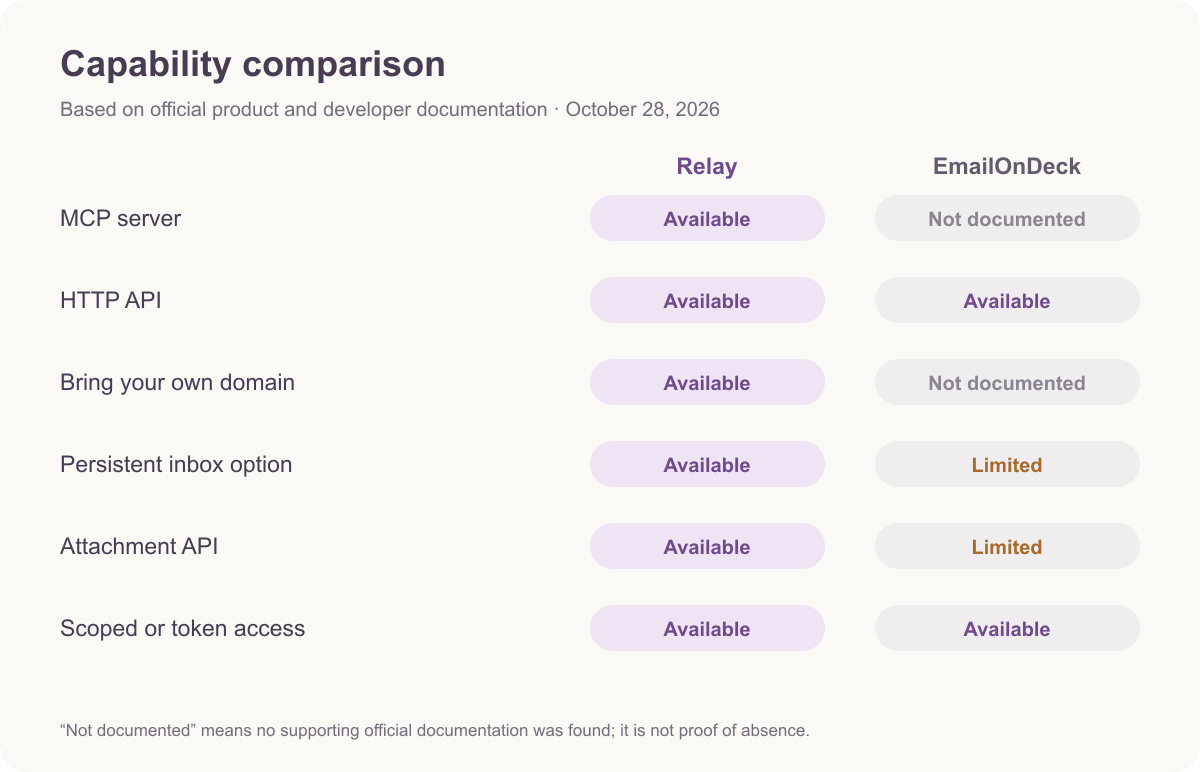
The matrix uses “not documented” conservatively. In particular, EmailOnDeck's exclusive domains are not evidence that customers can connect a domain they already own, and inbox attachment downloads are not the same as a documented attachment endpoint.
API and MCP differences that affect implementation
Relay's REST and MCP paths serve different integration styles. A backend calls /api/v1 with a scoped, revocable Bearer key; an agent uses MCP tools without custom function definitions. Guest passwords and account ownership provide distinct inbox-ownership models. Use the API reference and documentation for current request shapes.
EmailOnDeck's distinguishing developer feature is raw-message visibility. Its API exposes headers and full source through view_raw_email, complementing the web inbox's raw view. This suits tests of MIME structure, received headers, encoding, or authentication results. Relay documents sanitized HTML and attachments, but equivalent raw-source retrieval is not claimed here.
EmailOnDeck permits free sending only to other EmailOnDeck addresses, while Pro sends externally. Its sending flow uses proof of work. Relay has no send or reply capability, so it does not fit outbound conversations.
Retention, privacy, and access control
EmailOnDeck's FAQ says wiping usually occurs a couple of days after address creation, mail logs are wiped every few days or continuously, and no backups are kept. “Usually” is not a precise deletion service-level agreement, but it clearly signals a temporary lifecycle. Design tests to tolerate loss and never treat the inbox as an archive.
The free service requires neither an account nor personal details. EmailOnDeck says free inbox emails are viewable only by the user, and Pro describes private emails; those statements should not be inflated into undocumented team roles or identity-based enterprise controls. Its terms say information is not sold or rented, while also describing collection of cookies, IP, domain, and email data and compliance with lawful subpoenas. Sent messages include an originating-IP header.
Relay's no-fixed-expiry model supports continuity, but persistence is not automatically a privacy benefit. Teams should review retention expectations, minimize copied test evidence, and restrict keys to the required scope. Consult the privacy policy and support for lifecycle and data-handling guidance. Guest passwords and account ownership are more explicit access-building blocks than an address alone. Sanitized HTML reduces rendering risk, although links and attachments still require careful handling.
Pricing, advertising, and operating limits
EmailOnDeck's free tier is ad-supported, provides a temporary receiving address, and describes one email at a time. Pro removes ads and uses one-time Bitcoin payments for 30 days of access; additional payments add 30 days, and an approved six-month purchase receives a 15% discount. Because the cost varies with Bitcoin's value, no fixed dollar price is asserted here.
The Pro API starts at 25,000 calls per day, with increases available on upgrade. Traffic may be throttled or banned, and the service offers no SLA. Relay pricing or numerical quotas cannot be inferred from EmailOnDeck's sources, so consult the current Relay account options rather than expecting a like-for-like price claim in this review.
Which service fits which workflow?
Choose Relay for controlled, repeatable agent workflows
Relay is the better fit when an MCP-compatible agent must create and revisit inboxes, when API keys need defined scopes and revocation, or when test addresses should live on a domain you control. NS and MX connection options, plus public and private domain availability, make the domain model especially relevant to isolated QA environments. It is also the clearer choice when attachment retrieval belongs in the API workflow.
Choose EmailOnDeck for raw email and limited sending
EmailOnDeck is better when raw source inspection is central, when a conventional token API is sufficient, or when the test includes its documented sending modes. Its free browser service is useful for short-lived manual checks, while the published Pro API allowance gives developers a concrete capacity baseline. Its temporary wiping and lack of documented MCP make it less aligned with long-lived, agent-managed identities.
Relay limitations to include in the decision
Relay currently has no official SDKs, webhooks, SSE, dedicated OTP extraction, or send/reply capability. An agent can read a message and reason about its contents, but that is not the same as a purpose-built OTP endpoint. Applications needing push events must implement their own polling and orchestration. EmailOnDeck also has no official SDK or webhook documentation in the reviewed sources, but its raw-source and sending features remain genuine advantages.
Frequently asked questions
Is EmailOnDeck incompatible with AI agents?
No. An agent can use its HTTP API through custom tools. The difference is that Relay supplies an official MCP interface, while EmailOnDeck's reviewed documentation does not. Custom integration is possible without being equivalent to native MCP support.
Does EmailOnDeck Pro provide a persistent inbox?
The reviewed material does not establish that. Pro extends service access in 30-day payment increments, but the FAQ still describes temporary wiping, usually a couple of days after address creation. Do not confuse subscription duration with inbox retention.
Which is better for testing email headers and MIME source?
EmailOnDeck has the clearer documented advantage because its web interface and Pro API expose raw message source. Relay is more oriented toward sanitized message reading, attachments, scoped access, and MCP-driven inbox operations.
Sources and review notes
Reviewed October 28, 2026, using official product, FAQ, legal, and developer pages. No deliverability benchmark, uptime test, or unsupported performance score is included. Product capabilities and pricing can change; “not documented” describes the reviewed evidence, not a guarantee of absence.
- EmailOnDeck FAQ — inbox visibility, retention, attachments, and sending.
- EmailOnDeck Pro API documentation — token authentication, API actions, raw source, and daily call limit.
- EmailOnDeck Pro — free-tier context, Pro access, exclusive domains, advertising, and payment model.
- EmailOnDeck terms of use — account requirements, privacy, restrictions, and originating-IP handling.
- EmailOnDeck home page — current product identity and temporary-email positioning.