Relay and Mailinator both serve developers who need real incoming email, but Mailinator's public inboxes and paid private testing platform must be discussed separately. Mailinator's title tag reads Email Testing for QA Teams and Developers, and its homepage headline emphasizes Email Testing and SMS Workflow Testing for sign-ups, password resets, and 2FA codes with Selenium, Cypress, Playwright, or Puppeteer. Relay offers a compact REST and MCP surface for agent-controlled inboxes. Mailinator offers official SDKs, webhooks, routing, team administration, and published plan limits. Declaring a universal winner would hide the most important differences.
This article compares documented capabilities for authorized QA and AI-agent testing. It does not benchmark delivery, measure throughput, or imply that public disposable inboxes are appropriate for confidential accounts.
Official-source review method
The Mailinator research covered its official documentation, product API page, pricing, and privacy policy on October 28, 2026. Relay statements are limited to its documented REST, MCP, domain, inbox, and attachment behavior. Prices and limits below are a dated snapshot, not a substitute for checking current plan terms.
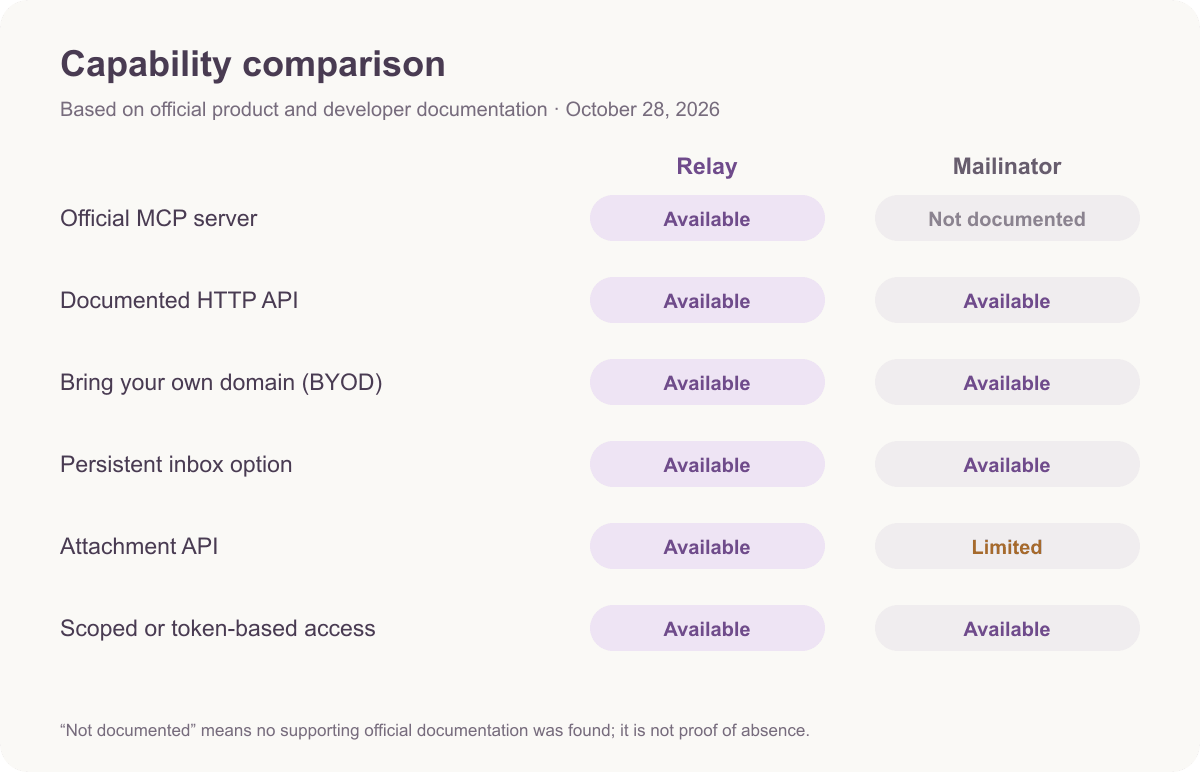
The phrase not documented means that a reviewed official source did not establish a feature; it is not evidence that the feature is absent. Not available is used only for an explicit official restriction. That distinction is especially important when comparing MCP with the many integration features Mailinator does document.
Feature comparison
| Capability | Relay | Mailinator |
|---|---|---|
| Official MCP server | Yes: inbox and message tools | Not documented |
| Documented HTTP API | Yes: REST | Yes: API for public and subscriber/private inboxes |
| Bring your own domain | Yes: NS or MX | Yes for subscribers: owned domain via MX, or Testinator subdomain |
| Persistent inbox option | Yes: no fixed inbox expiry | Yes for private mail while account is active, subject to storage rules |
| Attachment API | Yes | Limited by tier: public excludes attachments; private/API exposes list and fetch |
| Scoped or token-based access | Yes: scoped, revocable Bearer keys | Yes: API tokens and private team controls; Enterprise SAML SSO |
| Official SDKs | Not available | Java, JavaScript, C#, Go, Ruby, and Python |
| Webhooks | Not available | Public inbound and private webhook/routing workflows |
| Send from an inbox | Not available | Not available; Mailinator is receive-only, with separate message injection |
Mailinator clearly leads in several conventional integration categories. Relay's clearest distinction is official MCP access, not a broader SDK or webhook ecosystem.
MCP tools versus an SDK and webhook platform
A Relay agent connects to https://www.relaymcp.net/api/mcp, where the server exposes list_domains, list_inboxes, create_inbox, list_messages, and read_message. The agent can discover a domain, create an inbox, retain its ID, and poll for the expected verification message. An MCP host can mediate tool approval, and the operator can revoke the scoped Bearer credential. The Relay MCP documentation describes the connection.
Relay also exposes REST at https://www.relaymcp.net/api/v1 for custom runners and CI jobs that do not use MCP. There are no official Relay SDKs, so developers construct HTTP requests in their chosen language. There are also no webhooks or server-sent events; a workflow must poll responsibly rather than expect Relay to push arrivals.
Mailinator takes a more conventional developer-platform approach. Its official clients cover Java, JavaScript, C#, Go, Ruby, and Python. That can reduce integration work in an established codebase and provides a supported language-level abstraction instead of hand-written REST calls.
Mailinator also documents public inbound webhooks with no authentication or authorization on the public destination and strict rate/count limits. Subscriber rules can push private messages to an endpoint and inject mail into private domains. Those workflows need careful endpoint design, but they offer an event-driven option Relay does not currently match. For a QA platform already standardized on SDKs and webhook consumers, Mailinator may require less new infrastructure.
No official Mailinator MCP or AI-agent feature was found in the reviewed sources. A custom MCP adapter remains possible, just as a custom Relay SDK is possible; neither possibility should be confused with an officially documented integration.
Public and private inboxes are different products in practice
Mailinator's public @mailinator.com inboxes require no sign-up and are globally readable and deleteable. Public mail auto-deletes after a few hours; the official documentation does not give a more exact public timing in the reviewed record. Anyone who can read the inbox can potentially act on a magic link, so public addresses belong only in low-sensitivity tests with synthetic data.
Private Mailinator domains are controlled by the subscribing team. Private mail is not automatically deleted until team storage is exhausted; when storage is full, new mail pushes out old mail. Otherwise, private emails persist while the account remains active. Login, team management, API tokens, private-domain and webhook tokens, and Enterprise SAML SSO provide a substantially different access model from the public service.
Relay has no fixed inbox expiry and supports guest inbox passwords, account ownership, and scoped, revocable Bearer keys. This gives smaller agent workflows a direct way to combine persistence and inbox-level control without treating every inbox as public. It does not reproduce Mailinator's full team and Enterprise administration surface.
The privacy consequences follow the deployment model. Mailinator explicitly says public users should have no expectation of privacy. Its privacy policy also describes identifying, IP, cookie, and usage-data collection, U.S. processing, and third-party analytics. Relay's sanitized HTML addresses markup handling, not organizational privacy or prompt injection. On either service, agents should treat message bodies and links as untrusted input.
Attachments and domain configuration
Public Mailinator emails may not contain attachments; attachments are stripped or the message is not delivered. Private/API plans advertise attachments, and the API documents endpoints to list and fetch them. Therefore, “Mailinator supports attachments” is incomplete without the tier, and “Mailinator has no attachment API” is incorrect.
Relay exposes an attachments API without using Mailinator's public-versus-private attachment distinction in this comparison. If a test downloads files, validate type and size in your own pipeline and avoid letting an AI agent execute attachment instructions. The attachment security guide covers that boundary.
For domains, Mailinator subscribers can use a provided Testinator subdomain or bring a domain they own by changing its MX record. Plans include different numbers of private domains. Relay supports either NS or MX configuration for public or private domains, which provides an additional delegation pattern. The Relay domain guide is the source for current setup choices.
Pricing and published limits
At review time, Mailinator listed Public at $0 per month with unlimited public inboxes, no sign-up, and temporary storage. Verified Pro was shown at $0 with verification and limited private resources. Annual pricing listed Business at $79 per month billed yearly, Business Plus at $159 per month billed yearly, and Enterprise at $699 per month and up or custom. A two-week Business trial was advertised.
Mailinator also publishes throughput and volume constraints: Verified Pro up to 10 emails per second, 2,000 per month, and 60 per day; Business 20 per second, 100,000 per month, and 3,333 per day; Business Plus 100 per second, 300,000 per month, and 10,000 per day; Enterprise up to 500 per second with custom daily limits. Public usage and public webhook limits also apply. These figures are plan-specific, not benchmark results, and should be rechecked before purchase.
Verdict: choose the operating model, not a score
Relay is better when the primary consumer is an MCP-compatible AI agent, you want a small set of inbox tools without building an adapter, you need NS-or-MX BYOD flexibility, or you want no fixed inbox expiry with guest-password or account ownership controls. It is a focused agent-integration choice.
Mailinator is better when official language SDKs, inbound webhooks, private routing rules, team management, SAML SSO, or explicit throughput tiers are central requirements. Its free public inboxes are convenient for non-sensitive checks, while its paid private system supports a much broader QA organization. Mailinator is also the clear choice if your team does not want to maintain raw HTTP integration code.
Relay's limitations are material: no official SDKs, webhooks, SSE, automatic OTP extraction, or send/reply. Mailinator is receive-only as an email sender too, although it supports HTTP message injection and private routing. Neither should be selected for outbound user communication. For controlled agent-native mail, Relay has the simpler documented MCP path; for SDK-, webhook-, and enterprise-led testing, Mailinator is often the stronger platform.
Frequently asked questions
Does Mailinator support attachments?
Not in public inboxes: official documentation says public emails may not contain attachments. Private/API plans support attachments and provide attachment-list and attachment-fetch endpoints. Relay also documents an attachments API.
Is Relay more persistent than every Mailinator inbox?
No. Relay has no fixed inbox expiry, while Mailinator public mail auto-deletes after a few hours. Mailinator private mail can persist while the account is active, subject to team storage exhaustion and its push-out behavior.
Can either service push new email to my application?
Mailinator documents public inbound webhooks and private webhook/routing workflows, subject to applicable limits. Relay does not currently provide webhooks or SSE, so a Relay integration must poll through REST or MCP.
Sources and review notes
Reviewed October 28, 2026. Pricing and limits are dated official-source observations; product behavior should be rechecked before implementation.