Relay and Temp-Mail.Plus both receive email through developer-accessible systems, but they optimize different parts of the workflow. Relay centers on persistent inboxes, scoped access, and AI-agent tools through MCP. Temp-Mail.Plus combines deliberately short address lifetimes with an HTTP API that exposes HTML, attachments, and raw EML source.
The better choice depends on whether you need an agent-managed test identity that can remain useful across runs or a disposable address with an explicit expiry and original message-source access.
Review scope and methodology
This comparison uses the official Temp-Mail.Plus home page, API documentation, privacy policy, and terms, alongside Relay's documented product behavior. Sources were reviewed on October 28, 2026. No deliverability, latency, uptime, or parsing benchmarks were performed, and none are implied.
Not documented means the reviewed official material did not establish a capability. It does not prove the capability is unavailable. That distinction matters for Temp-Mail.Plus MCP support and for the eligibility rules behind its Custom domain type.
The lifecycle decision comes first
Temp-Mail.Plus lets free users choose an address lifespan of 10 minutes, one hour, or one day; paid plans offer longer lifespans. This is a useful control when a test should leave no long-lived mailbox behind. A developer checking one confirmation message can select a short window that matches the task instead of relying on later cleanup.
Relay takes the opposite lifecycle approach: its inboxes have no fixed expiry. That is better suited to a staging identity reused across a test suite, an agent that must inspect later messages, or a password-reset flow tested over several days. Persistence is not automatically safer or better. It creates a retention responsibility, so mailbox access, key revocation, and documented retention expectations still need deliberate review.
Feature comparison
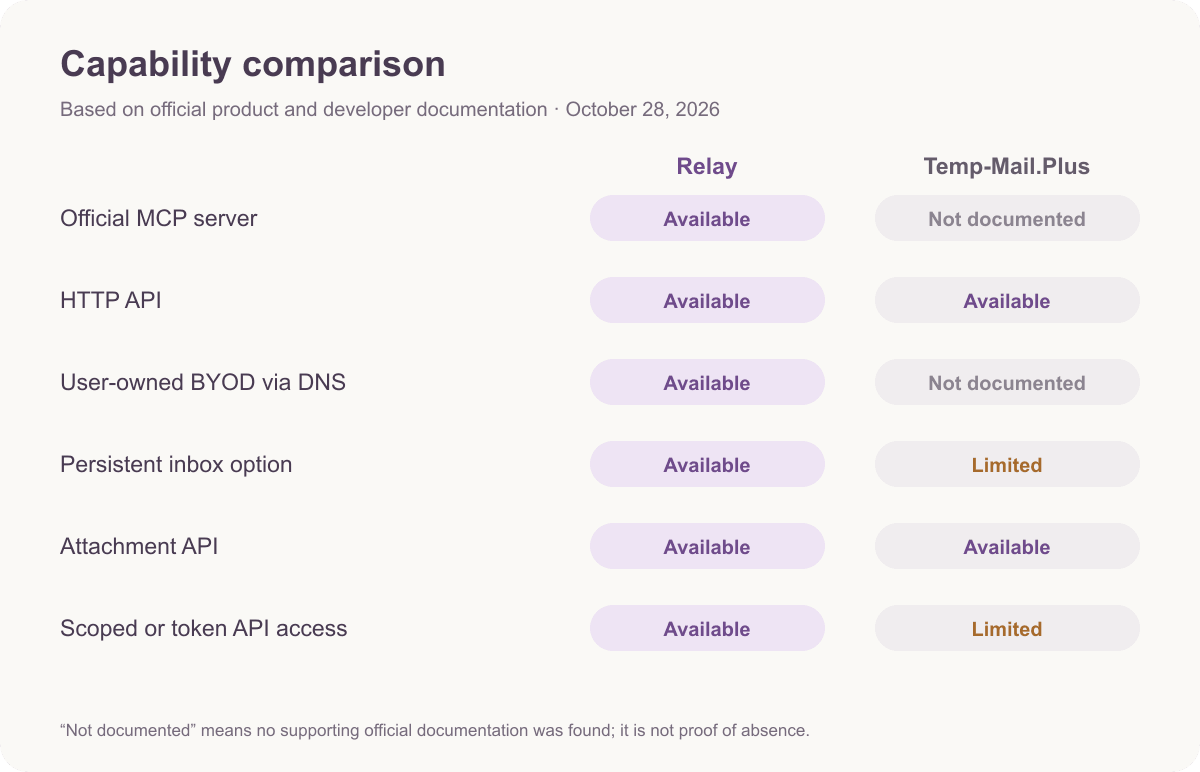
| Capability | Relay | Temp-Mail.Plus |
|---|---|---|
| AI-agent protocol | Official remote MCP server at /api/mcp |
No official MCP support found in reviewed sources |
| HTTP API | REST API under /api/v1 |
Documented API for addresses, messages, domains, history, source, and attachments |
| Authentication | Scoped, revocable Bearer keys | API key embedded in documented endpoint paths; key scoping not documented |
| Inbox lifetime | No fixed inbox expiry | Free choices of 10 minutes, 1 hour, or 1 day; longer paid lifespans |
| Domain model | Free domains plus user BYOD through NS or MX, public or private | Custom aliases and a Custom domain type documented; user-owned BYOD eligibility not established |
| Message content | Sanitized HTML and message retrieval | Full content including HTML, plus raw EML/source retrieval |
| Attachments | Authenticated attachment API | Attachment download by hash ID and filename |
| Basic web access | Guest password or account ownership model | No sign-up or password for basic use |
| Official SDKs | None currently official | None found; official curl and Python examples are provided |
| Send or reply | Not provided | No sending or reply endpoint found in the API documentation |
The most important nuance is the domain row. Temp-Mail.Plus does document custom email and domain inputs and an example domain whose type is Custom. It would be inaccurate to say custom domains are absent. The reviewed evidence does not, however, establish that any user can connect a personally owned domain through DNS, nor does it define equivalent public/private ownership controls. Relay explicitly documents that BYOD model.
API and MCP differences in practice
Relay exposes two ways to operate the same general inbox workflow. An HTTP client can call the REST base at https://www.relaymcp.net/api/v1 with a scoped Bearer key. An MCP-compatible agent can instead use https://www.relaymcp.net/api/mcp and call list_domains, list_inboxes, create_inbox, list_messages, or read_message. These tools let an agent discover and read mail without inventing HTTP request shapes. The Relay MCP documentation is the appropriate setup reference.
Temp-Mail.Plus is directly attractive to conventional HTTP automation. Its documented create route follows the form POST /api/v1/email/create/{your-api-key}. Other operations list messages and domains, retrieve a message, inspect history and rate-limit status, download an attachment, and fetch /api/v1/message/{message_id}/source/{your-api-key}. Raw EML is especially useful when a test needs original MIME structure rather than only a rendered body.
The authentication designs also differ. Relay keys are scoped and revocable Bearer credentials, which supports separating permissions by workflow. Temp-Mail.Plus places its API key in documented URL paths. That is a concrete API contract, not evidence of weak security by itself, but operators should keep credential-bearing URLs out of logs, screenshots, and transcripts. Review Relay API access and its account controls when designing credential handling.
Neither product should turn email into trusted agent instructions. Relay sanitizes HTML, but sanitized markup can still contain misleading text. Raw source access similarly preserves untrusted content.
Retention, privacy, and access control
Temp-Mail.Plus says messages and inbox data are automatically deleted after a limited time and cannot be recovered after deletion. Its basic web experience requires neither sign-up nor a password, while API operations require a key. These are different access surfaces; an API key does not turn the no-password web flow into an account-based security model.
Relay provides guest password and account-ownership models, plus scoped keys for developer access. Its no-fixed-expiry behavior makes it more appropriate for durable fixtures, but less aligned with a requirement for guaranteed short-lived addressing. Relay also supports public or private BYOD domains through NS or MX routing, described in the domain documentation.
For sensitive mail, neither a temporary label nor sanitized HTML is enough. Evaluate who can open the inbox, where credentials appear, what content is retained, and whether a test message contains a live credential or reset link.
Pricing and documented limits
The official Temp-Mail.Plus home page lists a $4.99 monthly plan with 1,500 API requests per month. It also describes free and premium options, but the reviewed excerpts do not establish every plan price or the complete free-plan API allowance. The API has a rate-limit lookup endpoint, while no numeric request-per-second limit was found in the reviewed documentation.
Temp-Mail.Plus therefore publishes a concrete entry price and monthly API allowance without publishing every operational number in the reviewed material. This article makes no unsupported Relay price comparison; check current plan and account information before making a cost decision.
Where Relay falls short
Relay has no official SDKs, webhooks, or SSE. An integration must use HTTP or MCP and handle polling where new-mail notification is required. Relay also does not provide built-in OTP extraction, send, or reply capabilities. A verification workflow needs its own conservative parser and authorization rules, while outbound mail belongs to the application or another provider.
Temp-Mail.Plus has the clearer documented raw-EML workflow and selectable short lifetimes. Relay is not the obvious replacement when original source inspection or automatic short expiry is the main requirement. Its broader agent interface does not remove the need for timeouts, deduplication, prompt-injection defenses, or credential management.
Which service fits which workflow?
Choose Relay when an MCP-compatible AI agent must create and inspect inboxes, when scoped revocable keys matter, when a test identity should persist without a fixed expiry, or when you need documented user-owned BYOD with public/private options. Its attachment API also fits controlled server-side file retrieval.
Choose Temp-Mail.Plus for short-lived manual addresses, deliberately ephemeral API fixtures, raw EML inspection, or a documented low-cost plan whose 1,500-request monthly allowance matches your volume. Its history and rate-limit endpoints are additional practical API surfaces.
Frequently asked questions
Does Temp-Mail.Plus support MCP for AI agents?
No official MCP support was found in the reviewed Temp-Mail.Plus pages. That is a documentation finding, not proof that no unofficial adapter exists. Relay provides an official remote MCP server with named inbox and message tools, so it has the clearer documented path for MCP-native agent workflows.
Is Temp-Mail.Plus only a 10-minute email service?
No. Its official home page offers free lifespan choices of 10 minutes, one hour, or one day, with longer lifespans on paid plans. Relay instead has no fixed inbox expiry. Choose based on whether automatic short retention or a reusable test identity is more important.
Which is better for raw email and attachment testing?
Temp-Mail.Plus explicitly documents raw EML/source retrieval and attachment downloads, making it the clearer choice for original-source inspection. Relay documents sanitized HTML and an authenticated attachment API, which fits controlled application processing. Test the exact MIME, file, and security requirements rather than assuming equivalent output.
Sources and review notes
Reviewed October 28, 2026, using official sources only. Product behavior and pricing can change; undocumented features remain unverified rather than declared absent.
- Temp-Mail.Plus home page: lifespan choices, no-sign-up basic use, pricing, API allowance, and privacy positioning.
- Temp-Mail.Plus API documentation: authentication, endpoints, Custom domain type, HTML, raw source, attachments, history, and rate-limit lookup.
- Temp-Mail.Plus privacy policy: automatic deletion and irrecoverability.
- Temp-Mail.Plus terms and conditions: official legal terms reviewed for context.