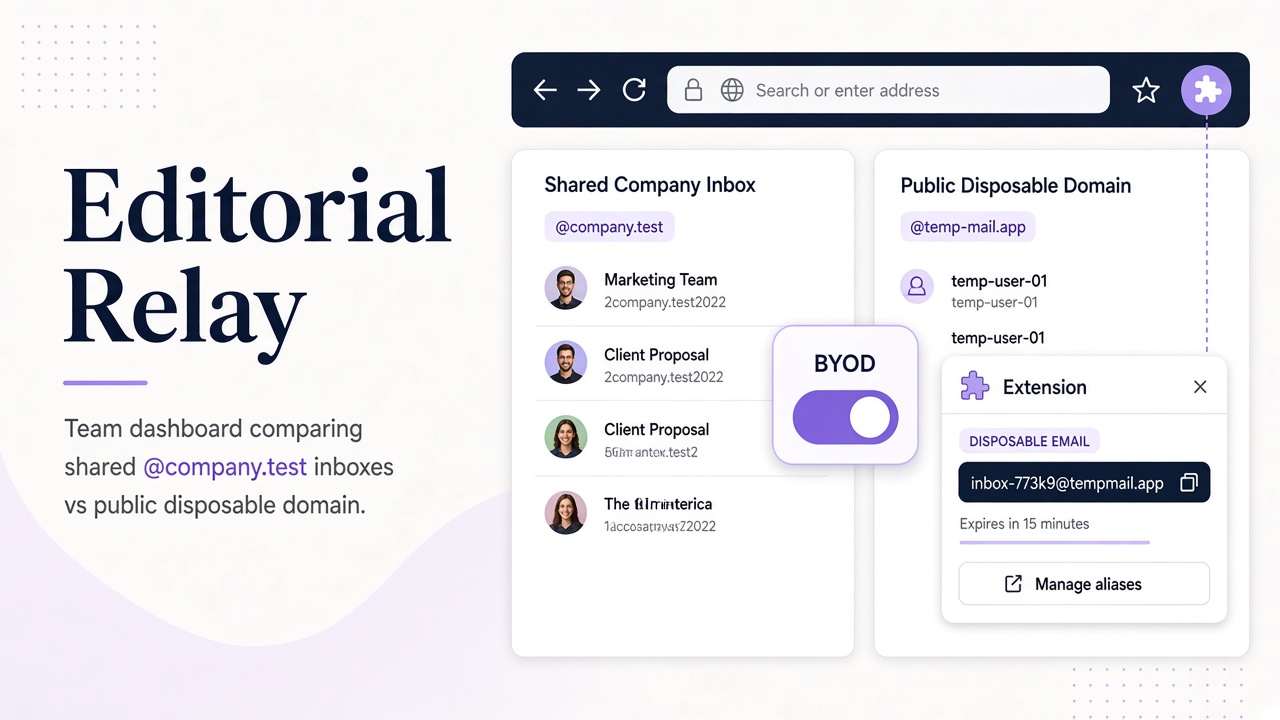
A shared test domain is convenient, but teams sometimes need addresses that resemble a product’s real mail environment. A custom domain can improve staging realism, clarify ownership, and make sender rules easier to test. It also introduces DNS, deliverability, and lifecycle responsibilities that should be understood before adoption.
Compare the options
| Setup | Best fit | Main responsibility |
|---|---|---|
| Shared test domain | Fast experiments | Inbox isolation |
| Custom staging domain | Team integration tests | DNS and sender setup |
| Production-like domain | Controlled pre-release testing | Strict access and monitoring |
Relay supports domain workflows with nameserver or MX verification. The Domains page explains the setup experience, and the documentation covers the conceptual steps. Never add a testing domain to a production-critical recovery flow without a clear owner and retention policy.
DNS is part of the test environment
Verify the intended MX record, wait for propagation, and test with a known sender. Keep unrelated DNS records intact and document who can change the zone. A domain appearing in a selector does not by itself prove that a message was delivered; verify the SMTP transaction, stored message, and API result separately.
Isolation and access
Use distinct local parts for workers or scenarios, avoid predictable addresses for sensitive workflows, and limit API keys to the account and scopes that need them. A custom domain should not change the rule that email content is untrusted.
Frequently asked questions
Is a custom domain required for email testing?
No. A shared verified domain is usually faster for early experiments.
Does BYOD improve deliverability automatically?
No. DNS configuration and sender reputation still matter.
Where can I see domain setup?
Start with Relay Domains and the API guide; use a dedicated staging domain for repeatable tests.
Team scenario: staging on mail-tests.example
Engineering connects a private domain, creates predictable local-parts per worker, and verifies MX before enabling signup specs. Product marketing still uses shared Free domains for quick experiments—both are valid when access boundaries differ.
| Stage | Domain type | Primary risk |
|---|---|---|
| Spike | Shared Free | Address collision |
| Staging | Private BYOD | DNS drift |
| Pre-prod | Production-like | Credential leakage |
Follow temporary email on your own domain for DNS sequencing.