Polling is easy to understand: ask whether a message exists, wait, and ask again. Webhooks reverse the direction: the service notifies your endpoint when an event occurs. Neither pattern is universally better. The right choice depends on latency requirements, network topology, operational maturity, and how much duplicate delivery your application can tolerate.
| Concern | Polling | Webhooks |
|---|---|---|
| Initial setup | Simpler | Requires public receiver |
| Latency | Interval-dependent | Near real time |
| Duplicate handling | Local loop | Mandatory idempotency |
| Firewall compatibility | Usually easier | Requires inbound HTTPS |
| Debugging | Inspect request history | Inspect event and delivery logs |
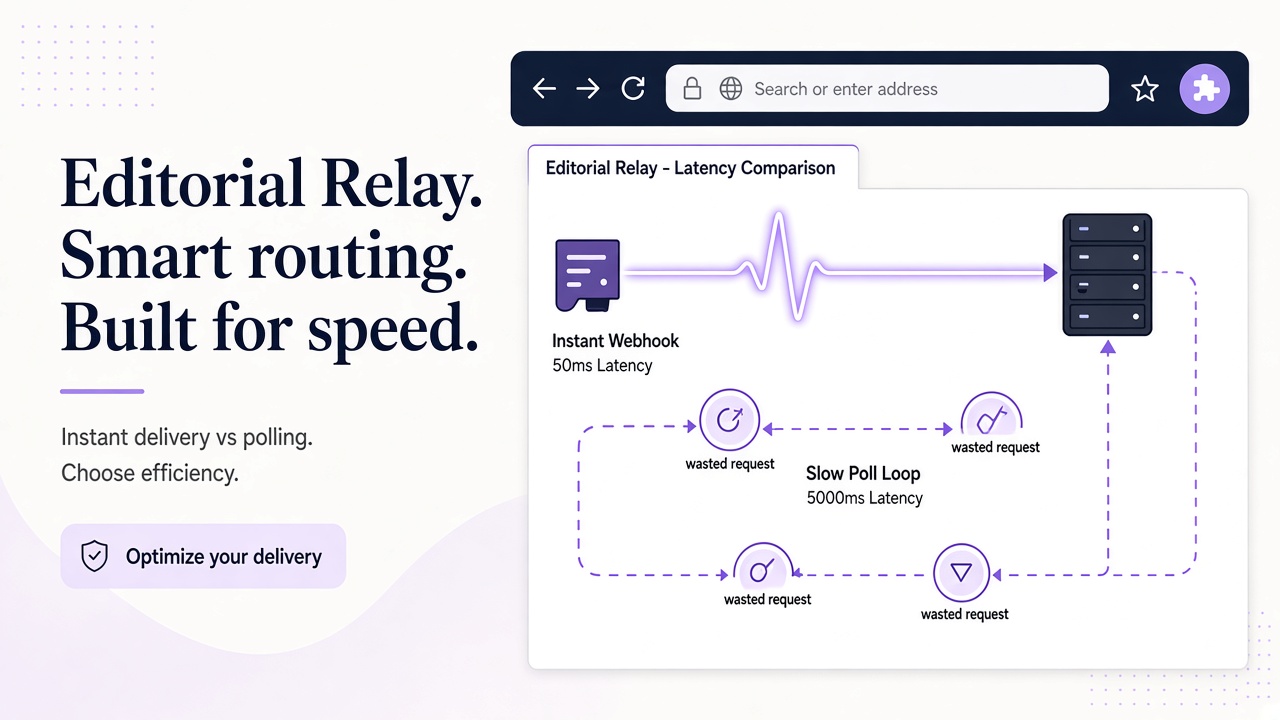
For a single Playwright test, polling is usually the clearest choice. For a production workflow that handles many inboxes, signed events can reduce unnecessary requests. Relay’s webhook documentation covers signed delivery and the API reference provides the contract.
The webhook receiver pattern
A receiver should verify the signature before parsing or queueing the event, acknowledge quickly, and process the event asynchronously. Use the event ID as an idempotency key. If the same event arrives twice, the second copy should not create a duplicate account action, notification, or test assertion. Fetch the full message only after confirming that the event belongs to an inbox and workflow you expect.
When polling is the better tool
Polling is appropriate for local debugging, short-lived CI checks, private networks, and flows where the test already has a strict deadline. Use a bounded interval and stop after the message is matched. Do not poll forever because an application failed to send mail.
Frequently asked questions
Are webhooks always faster?
They can reduce interval delay, but network retries and queueing still affect delivery time.
Can webhooks replace message reads?
Usually the event should identify a resource; fetch the message through an authorized API call.
How do I start?
Prototype with polling using the CLI, then move stable production flows to signed webhooks.
Side-by-side: one Playwright spec vs nightly load test
A single spec needs mail once; polling with a 45-second deadline is easy to reason about. A load generator maintaining fifty inboxes benefits from signed events that wake workers only when a message ID exists.
| Pattern | Typical owner | Stop condition |
|---|---|---|
| Poll | Test fixture | Matcher passes or deadline |
| Webhook | Service integration | Event ID deduped |
| SSE | Long-lived dashboard | Client reconnect policy |
Prototype both paths using the webhook events guide and keep polling helpers for local scripts.