Relay and AdGuard Temp Mail solve visibly similar problems with very different boundaries. Relay is built around programmable inboxes for applications and AI agents. AdGuard Temp Mail is a free browser-based disposable inbox for non-commercial personal use, with strong privacy statements and an explicit prohibition on automated agents and scripts.
That makes this less a feature-count contest than a choice between authorized developer automation and manual, short-term browser use.
Review scope and methodology
We reviewed AdGuard's official Temp Mail overview, privacy notice, and terms of service, together with Relay's documented API, MCP, domain, and access features, on October 28, 2026. The review did not measure delivery speed, inbox placement, uptime, or real-world privacy performance.
A feature marked not documented was not established by the official sources examined. It should not be read as a hidden feature or as definitive proof of absence. Explicit AdGuard statements, such as no attachments and no sending, are identified separately.
Start with permitted use, not automation convenience
AdGuard's terms describe Temp Mail as a browser-based service for non-commercial personal use by users aged 18 or over. They prohibit automated agents and scripts, scraping and mining, and a range of abusive behavior including bulk signups, promotional abuse, ban evasion, and credential stuffing.
Those restrictions are decisive for developers. Do not connect an AI agent, test runner, scraper, or mailbox-creation script to AdGuard Temp Mail, and do not treat the absence of a documented API as an invitation to automate the browser around the terms. Relay is the appropriate comparison for legitimate, authorized application testing because it actually documents developer interfaces.
This does not diminish AdGuard's intended value. A person who wants to open a browser, receive a permitted short-term message, and avoid creating an account is using the product in the context AdGuard describes.
Feature comparison
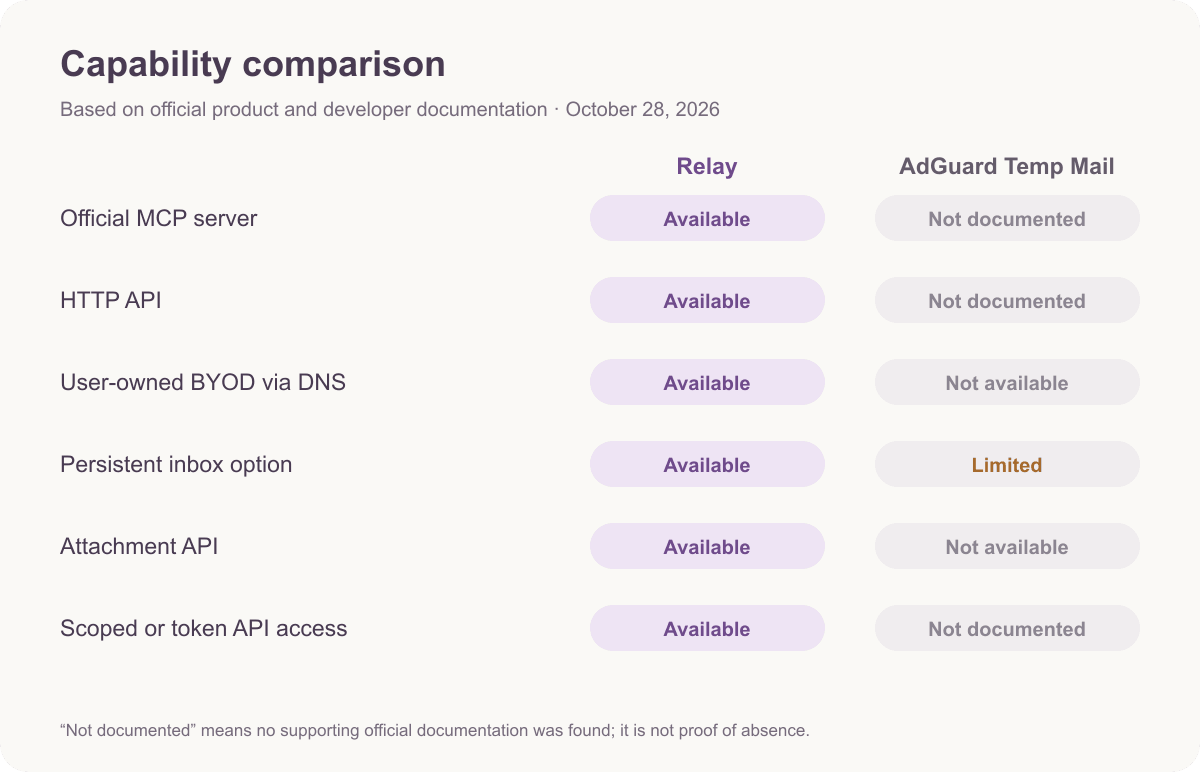
| Capability | Relay | AdGuard Temp Mail |
|---|---|---|
| Primary workflow | Programmable inboxes for developers and AI agents | Manual browser-based temporary inbox for personal use |
| MCP | Official remote server at /api/mcp |
Not found in official sources; automated agents are prohibited by terms |
| HTTP API | REST API under /api/v1 |
No official API documentation found; service is described as browser-based |
| Attachments | Authenticated attachment API | Explicitly not accepted |
| Domain choice | Free domains and BYOD via NS or MX, public or private | Users cannot choose a temporary domain |
| Inbox lifecycle | No fixed inbox expiry | Seven-day inactivity deletion, six-month maximum use, or immediate replacement |
| Access model | Guest password or account ownership; scoped revocable Bearer keys | No account; browser authentication cookie preserves access |
| Advertising | Not used as a differentiator in this review | Official overview says no ads |
| Sending | Not provided | Explicitly receiving-only |
| Price | Not priced in this source review | Completely free; no paid Temp Mail tier found |
API and MCP are different product categories here
Relay's REST base is https://www.relaymcp.net/api/v1, authenticated with scoped, revocable Bearer keys. Developers can provision inboxes, list and read messages, and retrieve attachments through documented HTTP routes. See the Relay API reference for current operations.
For an MCP host, Relay exposes https://www.relaymcp.net/api/mcp. Its tools are list_domains, list_inboxes, create_inbox, list_messages, and read_message. An agent can therefore discover an inbox and read a selected message through a standard tool interface. The MCP connection guide explains the integration surface.
AdGuard's official materials instead document a generated browser inbox. No official HTTP API, SDK, webhook, SSE, or MCP surface was found in the reviewed sources. More importantly, its acceptable-use terms rule out using automation with the service. A balanced verdict should not speculate about private endpoints or recommend reverse engineering.
Relay also supports attachments through its API, while AdGuard explicitly says its Temp Mail service does not accept attachments. This is a real functional difference, not a documentation gap. Both services are unsuitable when the workflow requires sending or replying: AdGuard explicitly says it cannot send, and Relay does not provide send or reply.
Retention and recovery behavior
AdGuard deletes a temporary inbox and its emails after seven days without opening or refreshing, after six months of maximum use, or immediately when a new address is generated. Deletion is irreversible. Clearing browser data can also lose the cookie needed to preserve access, so a generated address should not anchor account recovery or durable correspondence.
Relay has no fixed inbox expiry. That helps persistent test identities and longer investigations, but retention expectations should be reviewed using Relay's privacy policy rather than assuming automatic expiry. Guest passwords and account ownership provide documented access models; scoped keys can be revoked when an integration ends.
Privacy and access-control trade-offs
AdGuard says it does not collect or store users' IP addresses and does not share or sell personal data. It records a random mailbox name, creation and access timestamps, deletion time and reason, and a browser authentication cookie. The mailbox name is not associated with an IP address or user information, and received emails are physically deleted when the mailbox is deleted. The service is also completely free and shows no ads.
Those are meaningful strengths for manual privacy-focused use.
Relay's relevant controls are scoped revocable keys, guest password or account ownership, and public/private BYOD domains. Its HTML is sanitized, which helps when rendering untrusted markup but does not make the message's instructions trustworthy. Teams can review domain ownership options and account key controls for their own threat model.
Limits and cost without guesswork
AdGuard Temp Mail is completely free, and no paid Temp Mail tier was found. The separate AdGuard Mail product should not be confused with this service. Exact numeric request or rate limits were not published in the reviewed material. The terms say limits may cover address counts, message size, attachments, storage periods, and domains and may change to prevent abuse.
This review does not invent a Relay price or quota comparison. Cost-sensitive teams should compare current Relay terms separately, while recognizing that AdGuard's free manual service is not a permitted substitute for an automated test backend.
Where Relay falls short
Relay has no official SDKs, webhooks, or SSE. New-message workflows must use the available HTTP or MCP interfaces and their own polling and deduplication design. Relay also lacks built-in OTP extraction and does not send or reply to email.
For a one-off manual message, Relay's keys, API concepts, and persistent inbox model may be more infrastructure than the task needs. AdGuard is simpler when its personal-use terms and retention rules fit. Relay's persistence can also be a disadvantage if automatic short retention is the desired default.
Verdict by use case
Choose Relay for authorized AI-agent workflows, CI and staging fixtures, attachment retrieval, persistent test identities, scoped credentials, and user-owned domain routing. It is the clear choice when the requirement is a documented API or MCP server.
Choose AdGuard Temp Mail for permitted manual, non-commercial personal use when no account, no ads, a browser cookie, defined deletion, and strong stated IP-privacy practices matter more than programmability. It is not a choice for agent automation under the reviewed terms.
Neither service should receive important recovery mail or be used to evade third-party safeguards. Match the inbox to both the technical job and the permitted-use policy.
Frequently asked questions
Can an AI agent use AdGuard Temp Mail through browser automation?
No. AdGuard's official terms prohibit automated agents and scripts, as well as scraping and mining. This article does not recommend bypassing those restrictions. Relay is the documented option for MCP or REST-based agent workflows in applications you own or are authorized to test.
Does AdGuard Temp Mail delete mail after seven days?
Seven days applies when the address is not opened or refreshed. AdGuard also specifies deletion after six months of maximum use and immediately when a new address is generated. Deletion is irreversible. Relay inboxes have no fixed expiry; review the privacy policy and contact support for lifecycle and data-handling questions.
Can either service receive attachments for automated processing?
Relay documents an authenticated attachment API for controlled retrieval. AdGuard explicitly says Temp Mail does not accept attachments, so it cannot satisfy that requirement. Regardless of provider, treat attachments as untrusted files and apply size limits, validation, scanning, and isolated processing.
Sources and review notes
Official sources were reviewed October 28, 2026. Restrictions and product behavior may change; consult current terms before use.
- AdGuard Temp Mail overview: free access, no account, no ads, receiving-only behavior, attachment and domain limits, and deletion lifecycle.
- AdGuard Temp Mail privacy notice: mailbox records, browser cookie, IP-address statements, and physical deletion.
- AdGuard Temp Mail terms of service: browser-based scope, personal-use requirement, limits, and anti-automation and abuse restrictions.