Relay and Tempail both provide alternatives to a primary inbox, but their useful lifetimes and integration models differ sharply. Relay is designed for persistent, access-controlled inboxes operated through REST or MCP. Tempail presents an immediate browser address that expires after one hour, with a privacy policy describing permanent deletion and third-party advertising and analytics.
For developer automation, Relay has the documented toolset. For a brief manual interaction where one-hour disposal is desirable, Tempail's simplicity can be the advantage.
Review scope and methodology
We reviewed Tempail's official home page, privacy policy, and contact page, together with Relay's documented API, MCP, domain, and access behavior, on October 28, 2026. This was not a deliverability test, a security assessment, or an independent verification of deletion and advertising practices.
No official Tempail developer documentation was found in the reviewed pages. Accordingly, API, MCP, attachment, and custom-domain capabilities are described as not documented rather than categorically unavailable. The one-hour lifecycle and privacy disclosures, by contrast, have explicit official support.
What one hour means for design
Tempail's home page says its temporary addresses expire after one hour. Its privacy policy goes further: all incoming emails and personal data temporarily stored on the service are permanently deleted after one hour. An address can also be deleted manually.
That creates a clear boundary for a short task. A user who only needs to read an immediate message does not have to design a retention schedule or remember to remove a long-lived fixture later. It also creates obvious constraints: a delayed message, a follow-up reset, or an investigation that continues beyond the window cannot rely on the same inbox.
Relay has no fixed inbox expiry. This supports stable test users and agents that may need to revisit messages across runs. Persistence is operationally useful only when the workflow accounts for credentials, retention expectations, and regular access review. A permanent-by-default test inbox should not become an unreviewed archive of live tokens.
Feature comparison
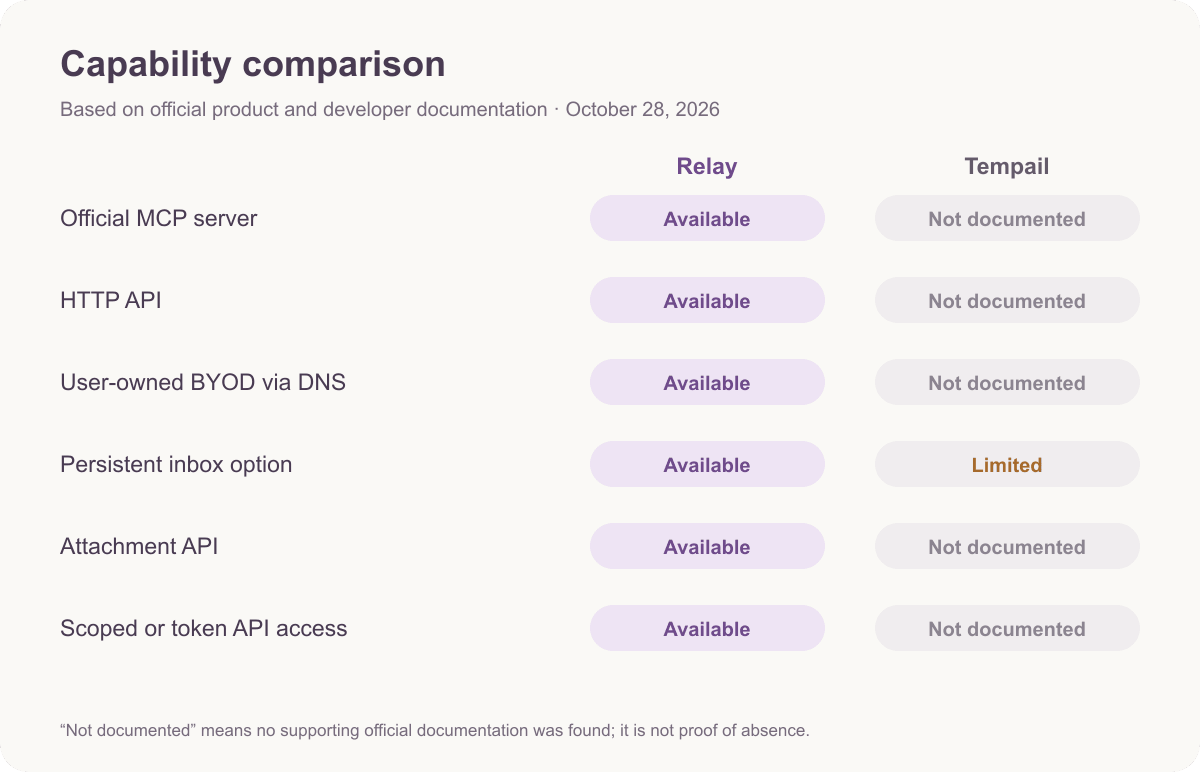
| Capability | Relay | Tempail |
|---|---|---|
| Product model | Programmable temporary and persistent test inboxes | Public browser-based disposable inbox |
| Address retention | No fixed inbox expiry | Addresses expire after one hour |
| Message/data retention | See Relay's privacy policy for lifecycle guidance | Privacy policy says temporarily stored email/data is permanently deleted after one hour |
| MCP | Official remote server at /api/mcp |
Not found in official reviewed sources |
| HTTP API | REST API under /api/v1 |
Not found in official reviewed sources |
| Attachments | Authenticated attachment API | Not documented on reviewed pages |
| Custom domains | BYOD through NS or MX, public or private | Not documented; the site generates its own address |
| Authentication | Guest password or account ownership; scoped revocable Bearer keys | No account, password, or inbox access-control mechanism described |
| Advertising and analytics | Not used as a comparison claim here | Privacy policy describes ads, cookies, Google Analytics, AdSense/DoubleClick, Disqus, and Yandex Metrica |
| Price | Not priced in this source review | Presented as free temporary mail; no paid plan table found |
MCP and HTTP versus a browser inbox
Relay's REST API is rooted at https://www.relaymcp.net/api/v1. A server-side client authenticates with a scoped, revocable Bearer key and uses documented inbox, message, and attachment routes. This is suitable for a test harness that must own every request and record explicit state.
An MCP-compatible agent can instead connect to https://www.relaymcp.net/api/mcp. The available tools are list_domains, list_inboxes, create_inbox, list_messages, and read_message. They cover discovery, provisioning, and retrieval without implying unsupported sending or event features. See the MCP documentation and API reference.
Tempail's official pages present a generated address, a browser inbox, and a waiting-for-email experience. No official REST endpoints, SDK packages, webhooks, SSE, or MCP server were found. That does not justify screen scraping or assuming an undocumented interface is stable. Developers who need a maintained contract should prefer a service that publishes one.
The attachment distinction follows the same rule. Relay documents authenticated attachment retrieval; Tempail's reviewed pages do not document attachment behavior. It would be unsafe to promise that a Tempail attachment can be downloaded programmatically, and equally inaccurate to claim official sources explicitly forbid every attachment.
Access control is separate from disposability
Tempail's reviewed pages describe no account, password, or other inbox access-control mechanism. The research therefore treats the browser inbox as public or weakly private rather than a secured mailbox. Avoid sensitive correspondence, durable recovery links, and anything whose exposure would matter.
Relay supports guest password and account-ownership models. Developer access uses scoped Bearer keys that can be revoked, which lets an integration reduce and withdraw privileges without relying on a prompt alone. These controls do not eliminate risk: a key in a log or an over-privileged agent can still expose messages.
Relay also sanitizes HTML. That helps with active markup, but a harmless-looking message can still contain phishing text or instructions aimed at an agent. Apply independent sender checks, link policies, and tool approvals.
Privacy, advertising, and deletion disclosures
Tempail's privacy policy says it does not sell, trade, or rent users' personal identification information. It also says generic aggregated demographic information may be shared with business partners, trusted affiliates, and advertisers. The policy describes cookies and named third-party advertising and analytics services.
Relay's comparison points are different: scoped access, no fixed inbox expiry, and public/private domain ownership. Review Relay account controls and domain options against the sensitivity and lifetime of the test data rather than treating temporary as a universal privacy guarantee.
Pricing and documented operating limits
Tempail presents itself as free temporary mail, and no paid pricing or plan table was found. No request-per-second, message-volume, or API quota was published in the reviewed official material. The one-hour expiry is the concrete limit to design around.
There is no basis in the supplied sources for a numerical Relay price comparison. Teams should evaluate current Relay costs and quotas separately, then compare like with like: a free browser inbox is not automatically equivalent to a persistent inbox with API and MCP access.
Where Relay falls short
Relay has no official SDKs, webhooks, or SSE. Event-driven consumers must implement polling, durable cursors, and deduplication rather than expect a push notification. It does not provide built-in OTP extraction and cannot send or reply to email.
For a single manual message, these integration details may be irrelevant and Relay may feel unnecessarily elaborate. Tempail's one-hour automatic deletion is also a genuine advantage when short retention is the goal. Relay users should review documented retention expectations, and no amount of MCP tooling removes the need to protect message content and attachments. Consult the privacy policy and support for lifecycle questions.
Verdict by use case
Choose Relay when an AI agent or test runner needs official MCP or HTTP access, when a stable inbox must outlive a one-hour session, when attachments require an authenticated API, or when your organization needs BYOD through NS or MX and scoped credentials.
Choose Tempail for a brief manual task where an immediately generated browser address and automatic one-hour deletion are more useful than developer interfaces. Its privacy and advertising disclosures should be part of that decision, especially for anything beyond low-risk test content.
Frequently asked questions
Does Tempail provide an official API for AI agents?
No official API or MCP documentation was found on the reviewed Tempail pages. This is a documentation finding, not proof that no internal endpoint exists. Relay is the clear choice when a supported REST or MCP contract is required because it publishes both interfaces and their authentication model.
Are Tempail messages deleted after one hour?
Tempail's privacy policy says all incoming emails and personal data temporarily stored on the service are permanently deleted after one hour. Its home page also says addresses expire after one hour. Relay inboxes have no fixed expiry; review the privacy policy and contact support for retention and data-handling questions.
Is Tempail a private, no-ads alternative to Relay?
The reviewed sources do not support that description. Tempail describes no account/password access-control mechanism, while its policy describes advertising, cookies, analytics, and possible sharing of generic aggregated demographic information. Relay offers more explicit developer access controls, but this article does not claim a universal privacy winner.
Sources and review notes
Official Tempail sources were reviewed October 28, 2026. Claims about deletion, advertising, and data handling are attributed to the provider rather than independently audited.
- Tempail home page: generated browser address, receiving inbox, free presentation, and one-hour address expiry.
- Tempail privacy policy: one-hour permanent deletion, access and data disclosures, advertising, analytics, cookies, and usage restrictions.
- Tempail contact page: official support surface and reviewed navigation context for the absence of published developer documentation.