Getnada is now best understood as a legacy name and domain leading to Inboxes, not as a separate current product. This comparison therefore evaluates the official Inboxes service and API rather than repeating older Getnada feature lists. Relay and Inboxes both support inbound test email, but they differ substantially in agent interface, domain control, and lifecycle documentation.
Inboxes offers a free disposable web service and an HTTP API positioned for high-volume automated testing. Relay offers REST plus an official MCP server, scoped revocable access, and no fixed inbox expiry. Official sources were reviewed on October 28, 2026; thin documentation is identified as such rather than converted into a negative claim.
Start with the product identity and integration model
The official getnada.com research result resolves to the operator's Inboxes service at inboxes.com. That matters for searches and implementation notes: “Getnada API” may lead developers to the current Inboxes API page, but the brand being reviewed is Inboxes. It would be misleading to compare Relay with an abandoned interface or to count Getnada and Inboxes as two competitors.
Relay's agent integration is explicit. Its remote MCP endpoint at /api/mcp exposes list_domains, list_inboxes, create_inbox, list_messages, and read_message. A compatible agent can provision and inspect mailboxes through standard MCP discovery. For non-MCP software, Relay also provides REST under /api/v1; the MCP guide and API reference describe the separate integration paths.
Inboxes documents an HTTP API for automated email testing, including a Get Message Contents endpoint that retrieves stored messages and attachments. API access uses an API key. No official MCP server or AI-agent-specific tooling was found in the reviewed pages, so a developer would normally wrap its HTTP endpoints in custom agent tools.
Detailed feature comparison
| Capability | Relay | Getnada legacy / current Inboxes | Evidence-based interpretation |
|---|---|---|---|
| Product identity | Relay | Getnada is the legacy domain; Inboxes is the successor service | Compare against Inboxes' current documentation |
| Official MCP server | Yes, at /api/mcp |
Not documented | Relay reduces custom MCP adapter work |
| HTTP testing API | REST /api/v1 |
Official API for high-volume automated testing | Both support scripted inbound-email tests |
| API access control | Scoped, revocable Bearer keys | API key; key scoping and revocation not documented | Similar credential category, different documented management |
| Inbox ownership | Guest password or account ownership | Web access-control details not documented; anonymous catch-all model described | Do not assume equivalent per-inbox controls |
| Address lifecycle | No fixed inbox expiry | Address remains while its domain is active; domains may be recycled | Relay offers the clearer durable-identity model |
| Message retention | No fixed inbox expiry is not a message-retention claim | Individual messages deleted after seven days | Inboxes gives a specific message-deletion window |
| Bring your own domain | NS or MX, public or private | Self-registered custom domains described as a feature the operator wanted to add | Current BYOD remains undocumented, not proven impossible |
| Attachment API | Yes | Yes, through Get Message Contents | Both document automated attachment retrieval |
| HTML or raw source | Sanitized HTML | HTML-specific and raw-source fields not documented | Do not infer raw MIME access from “message contents” |
| Pricing and API allowance | No unsupported quota asserted | Free web service; API free up to 200 requests/month | Inboxes publishes a modest free API allowance |
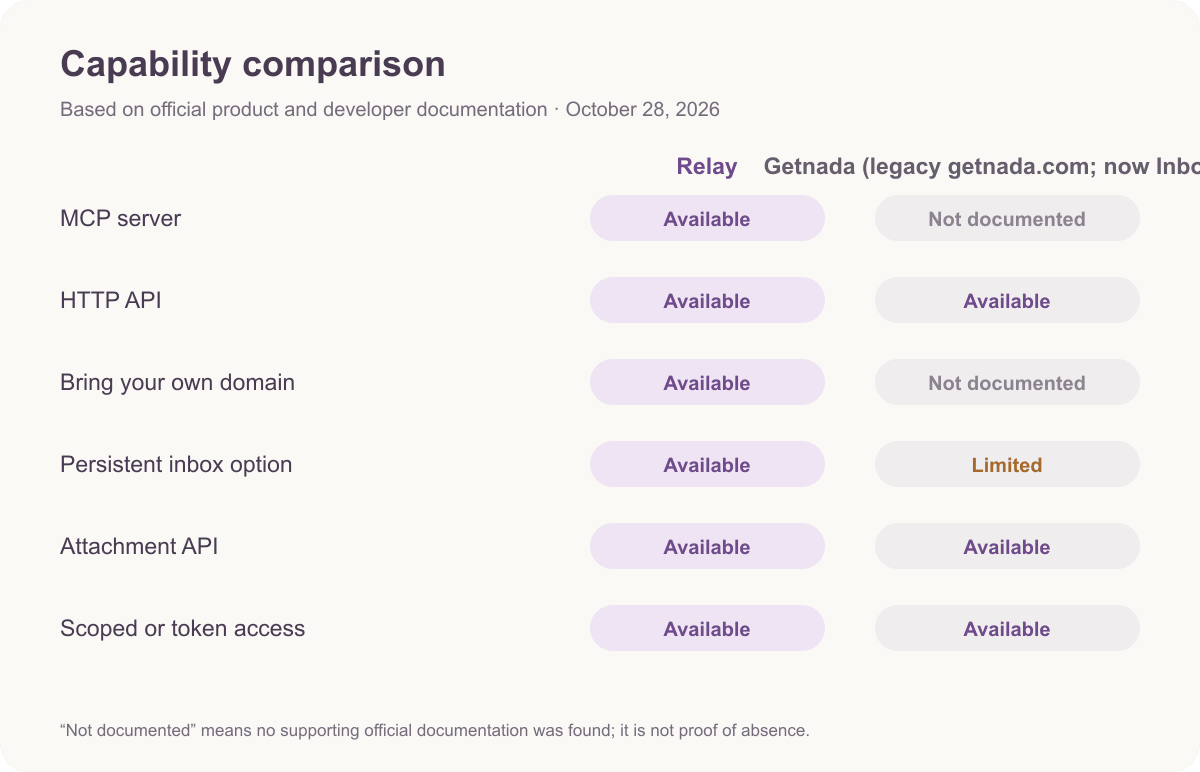
The custom-domain row deserves care. An official Inboxes blog post says the operator would like to add self-registered custom domains to the API. That is evidence of a proposed feature in the reviewed material, not documentation that users can currently connect their own domains. The matrix therefore marks BYOD as not documented rather than unavailable.
Agent control versus an automated-testing endpoint
The practical Relay advantage is not merely that it has an API. Inboxes has one too. Relay gives an MCP client pre-defined domain, inbox, and message tools, while its scoped Bearer keys can be revoked independently. This is useful when a coding agent or test agent needs controlled mailbox administration without a developer designing a separate tool contract. Account ownership and guest inbox passwords provide explicit models for managing who can use an inbox.
Inboxes is oriented toward conventional test automation. Its API page specifically names high-volume automated testing and says messages and attachments are stored in a database for retrieval through Get Message Contents. For an existing HTTP-based test runner, that may be enough. An API key is a familiar integration pattern, and attachment retrieval is documented rather than assumed.
What is not documented also shapes implementation. No official Inboxes SDK, webhook, SSE, raw-source interface, or MCP support was found in the reviewed pages. These omissions do not prove the service cannot be adapted, but they mean a team should budget for polling, custom schemas, and its own agent integration instead of expecting Relay-equivalent MCP behavior. Consult the Relay documentation when mapping the equivalent tool workflow.
Domain recycling and message retention belong in the test design
Inboxes says addresses are not deleted while their domain remains active, but domains can be recycled and retirement is announced one month in advance. Individual messages are deleted after seven days. Consequently, “inboxes are not deleted” is conditional, not a promise of a permanent test identity or a permanent message archive.
This lifecycle can be reasonable for a short QA cycle. A team can revisit an address during the active domain period, provided it only needs messages from the last seven days. It is less suitable for a durable fixture whose address must survive provider-domain changes or whose audit trail depends on older email.
Relay has no fixed inbox expiry, which better supports persistent agent-managed identities. That fact alone says nothing about unlimited storage or indefinite message retention, and this review makes no such claim. Relay also supports customer-controlled domains through NS or MX, with public and private availability. A private test domain can separate organization fixtures from a provider-controlled namespace; review the domain model before delegating DNS or changing MX records.
Privacy and access require separate questions
Inboxes describes an anonymous, catch-all or free-for-all web-inbox model and says it makes every effort to protect anonymity, with no personal details logged or collected. It also warns users not to use the service for important messages and prohibits illegal activity and abuse. Those statements support casual disposable use; they do not document granular inbox permissions, team roles, or identity-based access control.
The Inboxes API does use an API key, so API authentication should not be confused with the openness or anonymity of the web service. Whether obtaining that key requires an account was not established in the fetched official material. Likewise, web attachment behavior beyond the API was not documented, even though API attachment retrieval is clear.
Relay's guest passwords and account ownership answer inbox-access questions more directly, while scoped revocable keys address automation credentials. Sanitized HTML helps when message markup is rendered, but teams should still treat URLs and attachments as untrusted. Neither service should receive sensitive production mail solely on the basis of an anonymity or access-control claim.
Pricing and limits: distinguish free allowances from capacity
The Inboxes web service is free. Its API can be tried free for up to 200 requests per month, according to the official API page. Paid API pricing and endpoint-specific or per-second limits were not found in the reviewed sources. Although the API is marketed for high-volume automated testing, that wording is not evidence of unlimited requests.
This comparison does not invent a Relay price or quota. Current account requirements should be checked through the Relay account page. The meaningful cost question is broader than the free allowance: whether 200 monthly API requests cover the evaluation, whether a custom integration must be built, and whether domain and credential controls reduce operational work later.
Verdict for agent-managed and conventional QA
Choose Relay when inbox control is part of the agent's job
Relay is the better fit for MCP-native agents, stable test identities, scoped and revocable API credentials, and domains controlled through NS or MX. It is also preferable when public/private domain availability and guest or account ownership must be explicit parts of the test architecture. These are focused advantages, not evidence that Relay has every developer feature Inboxes offers.
Choose Inboxes for straightforward HTTP-based disposable testing
Inboxes is the better fit when a free browser inbox is enough, when an existing test runner needs a conventional API with message and attachment retrieval, or when a seven-day message window matches the fixture. Its up-to-200-requests monthly free API allowance is useful for evaluation. It is less compelling when durable provider-independent addresses, native MCP, or documented granular access controls are mandatory.
Relay currently has no official SDKs, webhooks, SSE, dedicated OTP extraction, or send/reply. Inboxes has no documented send/reply in the reviewed material either, and its real-time features are not documented. If a test must reply, stream events, or use vendor-maintained SDKs, neither should be assumed to satisfy it without further verification.
Frequently asked questions
Are Getnada and Inboxes the same service for this comparison?
Getnada is the legacy brand and domain; the official domain leads to the current Inboxes service. They should not be counted as two independent products. Current integration decisions should use Inboxes documentation.
Does an Inboxes address that persists also retain every message?
No. Inboxes distinguishes address and message lifecycles. Addresses remain while the domain is active, but individual messages are deleted after seven days, and domains may be recycled with advance notice.
When is Relay worth the additional integration choice?
Relay is most relevant when an MCP-compatible agent must create and manage inboxes directly, when scoped revocable keys are required, or when tests need an inbox on your own domain. For simple HTTP polling and attachment retrieval, Inboxes may already be sufficient.
Sources and review notes
Reviewed October 28, 2026, using the official legacy domain, current Inboxes pages, API documentation, custom-domain post, and terms. No delivery test, performance benchmark, user-count claim, or unsupported feature score is included. “Not documented” refers only to the reviewed official evidence.
- Getnada legacy domain — official-domain relationship and redirection to Inboxes.
- Inboxes home and FAQ — free service, address and message retention, anonymity, and usage warnings.
- Inboxes API — automated-testing purpose, API key, message and attachment retrieval, and 200-request monthly free allowance.
- Inboxes custom-domain post — proposed self-registered custom-domain functionality.
- Inboxes terms — current official terms location and free temporary-email service scope.