Guerrilla Mail and Relay solve the same narrow problem—receiving mail without a personal inbox—with very different lifecycles. Guerrilla Mail brands itself Disposable Temporary E-Mail Address and tells visitors to avoid spam and stay safe with a disposable address. Relay combines persistent inbox options with REST and MCP tools intended for controlled developer and AI-agent workflows. Sending support and domain pricing also prevent this from being a one-sided comparison.
Review method and scope
This review used Guerrilla Mail's official About, API, and Terms pages, checked on October 28, 2026, alongside Relay's documented features. It does not claim measured delivery speed, spam-filter performance, uptime, or account-creation success on third-party sites. Use either service only for testing and automation you are authorized to perform.
Where the official material does not establish a capability, this article says not documented. That phrase does not mean the capability is definitively unavailable. Not available or no is reserved for behavior the official sources explicitly exclude. In particular, a missing attachment endpoint in the reviewed API documentation is not proof that every attachment interaction is impossible.
Feature comparison
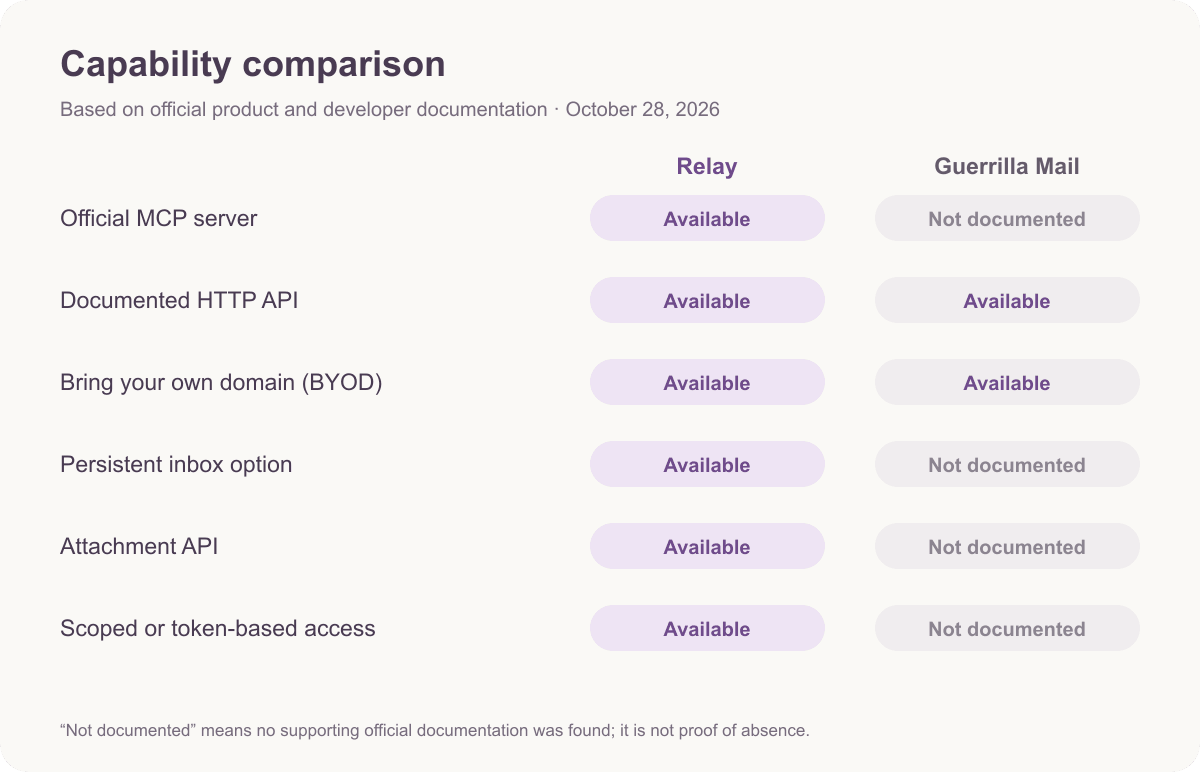
| Capability | Relay | Guerrilla Mail |
|---|---|---|
| Official MCP server | Yes: named inbox and message tools | Not documented |
| Documented HTTP API | Yes: REST with Bearer keys | Yes: public HTTP/JSON API with session state |
| Bring your own domain | Yes: NS or MX, public or private | Yes: $9.99/year, owner-only or shared |
| Persistent inbox option | Yes: no fixed inbox expiry | Not documented; messages expire after about one hour |
| Attachment API | Yes | Not documented in the official API page |
| Scoped or token-based access | Yes: scoped, revocable keys | Session and Inbox-ID controls; equivalent scoped tokens not documented |
| Website sending | Not available | Yes, through Compose; outgoing Terms apply |
| API sending or reply | Not available | Not documented |
| Message lifetime | No fixed inbox expiry | About one hour; extensions can add up to two hours |
Guerrilla Mail's sending support is a real functional difference. Relay's persistence and MCP integration are also real advantages, but neither cancels out the other. Start with the required test journey rather than a generic feature count.
Two integration models: tools or session polling
With Relay, an MCP host connects to https://www.relaymcp.net/api/mcp and receives named tools: list_domains, list_inboxes, create_inbox, list_messages, and read_message. A browser agent can create an inbox, save its ID with the test run, submit the address to an authorized application, and poll until the expected message arrives. The host can expose only the operations the workflow needs. See the MCP documentation for connection details.
For non-MCP automation, Relay's REST base is https://www.relaymcp.net/api/v1. Requests use scoped, revocable Bearer keys. That makes credential ownership explicit in a CI system or agent runner and allows a key to be retired independently. The API guide covers the developer surface.
Guerrilla Mail documents a public JSON API over HTTP at http://api.guerrillamail.com/ajax.php. Browser and API session cookies maintain state. Its polling functions include check_email, while fetch_email retrieves a message; only email owned by the current session ID can be fetched. This model can be convenient for a small client that does not want account registration, but the test must preserve session state and avoid losing the identifiers it needs.
Retention changes the test design
Guerrilla Mail's retention rules are unusually specific. Quarantined mail is deleted if it is not picked up within one hour. Once delivered to an inbox, mail receives one additional hour or remains until deleted. The API documentation says emails expire after 60 minutes, and an address extension can add one hour at a time up to two additional hours.
That design suits a deliberately ephemeral interaction: request a message, inspect it promptly, and allow the fixture to disappear. It is risky for a queue that may pause overnight or a failed CI job someone will inspect the next morning. Polling intervals and timeouts should be comfortably inside the documented lifetime, without hammering the service.
Relay has no fixed inbox expiry. This makes it easier to separate message arrival from later diagnosis, preserve an inbox across a multi-stage test, or hand a failure to a human. It does not eliminate the need for a cleanup policy, and it should not be interpreted as permanent archival storage. The operational question is whether your workflow benefits from continuity rather than a fixed short clock. Consult Relay's privacy policy and support for retention and data-handling guidance.
Access, privacy, and custom domains
A default Guerrilla Mail inbox requires no registration, but anyone who knows the Inbox ID may access it. Scramble Address creates an alias that is harder to guess; obscurity is not the same as scoped authorization. API fetching is restricted to messages owned by the current session, which is an important session boundary but not equivalent to Relay's revocable key model.
Guerrilla Mail also supports a domain you own for a documented price of $9.99 USD per year. Incoming mail can be accessible only to the owner or shared with everyone. This is a notable counterpoint to simplistic claims that disposable services never offer private domain workflows. Relay supports BYOD through NS or MX and offers public and private domains; compare the current setup requirements in the domain guide.
Guerrilla Mail says logs are normally off because of traffic and resource constraints. It may use anonymized data from obvious spam for anti-spam, anti-malware, and anti-phishing research, and it documents session, preference, Google Analytics, and Google AdSense cookies. Neither that policy nor a short expiry should be treated as a guarantee of anonymity.
Sending, attachments, and operating limits
Guerrilla Mail exposes Compose on the website, and its Terms regulate outgoing messages. If a manual test must send as well as receive, that is a concrete reason to choose it. The reviewed official material did not document an API send or reply endpoint, so website sending should not be assumed to be programmable. Relay currently has neither send nor reply.
Outgoing Guerrilla Mail messages include an X-Originating-IP header. Its Terms prohibit spam, harassment, fraud, impersonation, phishing, illegal content, and resource abuse. This matters for both compliance and test evidence: disposable addressing does not conceal every network identifier.
The official API page did not document an attachment-download API. Guerrilla Mail's Terms mention attachments only while disclaiming responsibility for message content, leaving exact supported behavior unresolved in this research. Relay documents an attachments API, making it the clearer choice when programmatic attachment retrieval is a requirement.
Guerrilla Mail may rate-limit API use but does not publish thresholds, and asks clients not to check too often. No numeric limit should be invented. Implement bounded polling, backoff, and a test timeout on either platform.
Practical verdict
Relay is the better fit for an MCP-native agent, a long-running or delayed test, scoped and revocable credentials, account-owned inboxes, documented attachment retrieval, or flexible NS/MX domain setup. Its value is the controlled automation surface rather than a promise that every third-party website will accept its addresses.
Guerrilla Mail is the better fit for a short, low-sensitivity task that benefits from no-registration HTTP sessions, a deliberately brief retention window, website sending, or an inexpensive custom domain at the documented $9.99 yearly price. Its public-by-Inbox-ID default still requires synthetic data and careful handling.
Relay does not currently offer official SDKs, webhooks, server-sent events, automatic OTP extraction, or send/reply. Teams needing those capabilities must build around the REST or MCP interfaces or choose another component. Guerrilla Mail therefore wins specific outgoing-manual-test scenarios, while Relay is stronger for controlled, persistent agent workflows—not universally superior.
Frequently asked questions
Can Guerrilla Mail replace Relay MCP for an AI agent?
Not directly from the reviewed official documentation. Guerrilla Mail provides an HTTP/JSON API; no MCP server was found. You can build an adapter, but Relay already exposes inbox and message tools through its remote MCP endpoint.
Is Guerrilla Mail always public?
Its default disposable inbox is accessible to anyone who knows the Inbox ID. Its paid custom-domain mode can instead be owner-only or shared with everyone. Do not transfer assumptions about the paid domain mode to an ordinary disposable inbox.
Which service is better for a next-day test review?
Relay is the clearer fit because it has no fixed inbox expiry. Guerrilla Mail documents roughly one-hour retention with limited extensions, so a next-day review should not depend on the original message remaining there.
Sources and review notes
Reviewed October 28, 2026. These official sources support the retention, API, domain, sending, privacy, and restriction statements above.