Relay and Internxt Temporary Email address opposite ends of the temporary-inbox spectrum. Relay provides persistent, programmable inboxes with REST and MCP access for developers and AI agents. Internxt offers a free browser generator whose address and inbox expire after three hours of inactivity, accompanied by strong product-page privacy statements.
If the workflow begins with an agent tool call, Relay has the documented interface. If it begins and ends with a person briefly using a random browser address, Internxt may be the simpler fit.
Review scope and methodology
This review examined Internxt's official Temporary Email product page and general legal page, plus Relay's documented developer and inbox behavior, on October 28, 2026. It is a source-based feature comparison, not a security audit, deliverability test, or measurement of deletion on either provider's infrastructure.
When the official Temporary Email page did not document an API, attachment feature, or custom-domain control, this article calls that capability not documented. It does not claim to prove that no unrelated or undocumented Internxt capability exists.
A three-hour boundary changes the workflow
Internxt's central lifecycle rule is explicit: the email address and inbox expire after three hours of inactivity. Received messages appear in the browser inbox, and emails are deleted when the temporary address is closed. Its FAQ says deleted emails cannot be recovered.
This makes Internxt suitable for a bounded interaction where later access is unnecessary and automatic expiry is desirable. It is a poor fit for a fixture that must survive a weekend, receive a later password reset, or preserve evidence across repeated test runs.
Relay has no fixed inbox expiry. A stable address can belong to a staging persona or an agent workflow for as long as the owner needs it. Persistence supports continuity, but it also calls for a retention plan and regular access review. Consult the privacy policy and support for questions about stored data. Temporary describes a use pattern; it should not be mistaken for an automatic retention guarantee.
Feature comparison
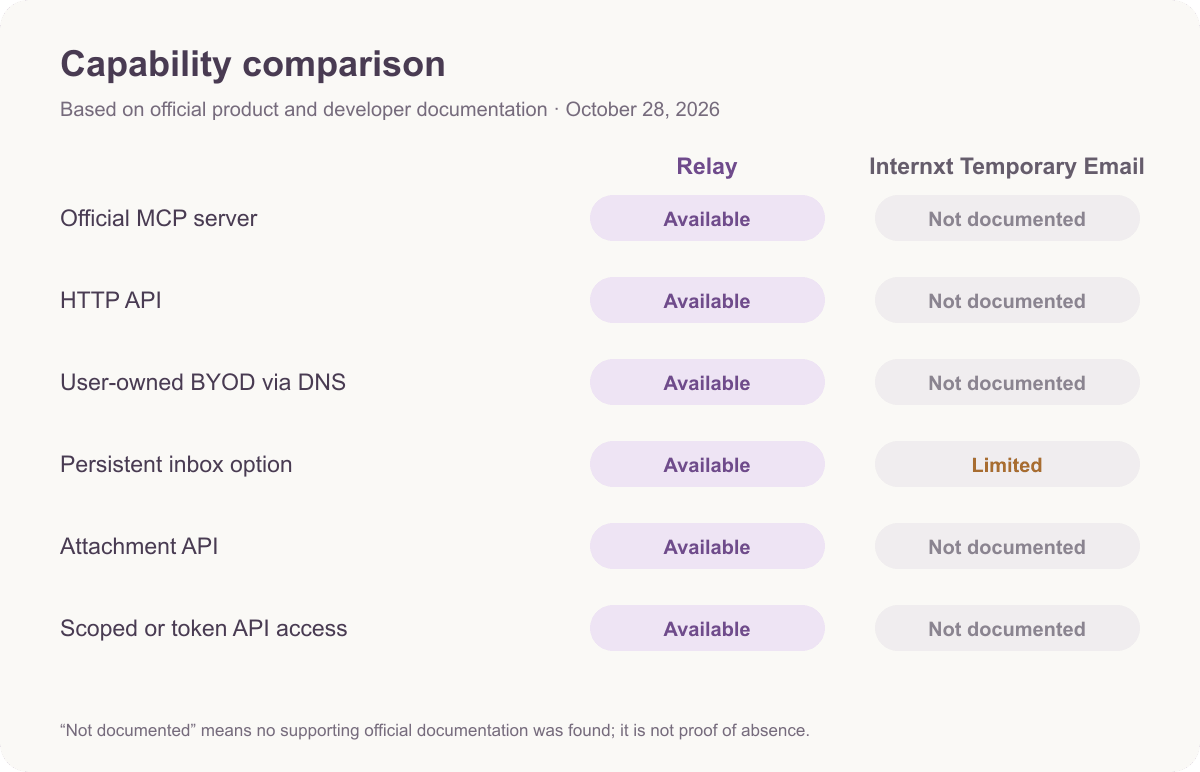
| Capability | Relay | Internxt Temporary Email |
|---|---|---|
| Main interface | REST API, MCP, and inbox access model | Browser-based random-address generator and inbox |
| MCP | Official remote server at /api/mcp |
Not found on official Temporary Email sources |
| HTTP API | REST API under /api/v1 |
Not found on official Temporary Email sources |
| Address lifecycle | No fixed inbox expiry | Expires after three hours of inactivity |
| Custom domains | BYOD through NS or MX with public/private options | Not documented for this tool |
| Attachment API | Documented authenticated attachment access | Not documented on the reviewed product page |
| Access control | Guest password or account ownership; scoped revocable Bearer keys | No account, password, API, or per-mailbox control documented |
| Message rendering | Sanitized HTML | Browser inbox display documented; raw/HTML API fields not documented |
| Sending or reply | Not provided | Not documented; the page describes receiving |
| Temporary Email price | Not priced in this review | Free; no paid Temporary Email tier found |
Agent and API workflows
Relay provides a conventional REST base at https://www.relaymcp.net/api/v1. Scoped, revocable Bearer keys let a server-side integration create and inspect mailboxes without exposing a personal inbox. The same credential model supports an official remote MCP endpoint at https://www.relaymcp.net/api/mcp.
Through MCP, an agent can use list_domains, list_inboxes, create_inbox, list_messages, and read_message. That is a specific, bounded tool surface rather than a claim that the model can manage every email function. The Relay MCP guide and REST API documentation describe the current integration options.
Internxt's official page documents no equivalent HTTP or MCP interface for this temporary-email tool. It presents an immediate browser generator and inbox instead. Consequently, Relay is the clearer choice for an agent that must provision an address, poll for a message, and retrieve selected content as part of an authorized test.
Relay also has an attachment API, while attachment handling is not documented on Internxt's reviewed page. Do not infer that every browser message lacks an attachment or that an unofficial extraction path is supported. The accurate conclusion is narrower: Relay supplies a documented developer route; Internxt does not document one for this product.
Privacy claims and access boundaries
Internxt says it does not have access to the temporary email and does not store personal information or received emails. It also says recipients do not gain the user's name, photo, phone number, email address, or other real-account information. These are significant product-page privacy claims and should be attributed to Internxt rather than presented as independent verification.
The page does not document an account, password, API authentication, or per-mailbox access-control feature for the generator. Anonymous use and access control are not synonyms. Before receiving sensitive material, ask who can open the address and what happens if browser state is lost.
Relay's controls are more explicit for developer workflows: guest password or account ownership, scoped keys that can be revoked, and sanitized HTML. Sanitization reduces markup risk but cannot stop a message from containing a malicious instruction or misleading link.
Domain ownership and test identity
Relay supports user-owned domains through nameserver or MX connection, with public or private availability. This allows a team to separate test traffic under infrastructure it controls. It does not make the underlying messages safe, and public/private domain availability should not be confused with inbox authentication. See Relay domain options.
Internxt's reviewed tool generates random addresses and lets the user change address by refreshing. No custom-domain control was documented. That is entirely reasonable for a simple privacy tool, but it does not meet a requirement for organization-controlled DNS or a recognizable private test namespace.
Pricing and limits
Internxt labels Temporary Email free, and no paid tier specific to this tool was found. No exact request, message-volume, or rate limit was published in the reviewed product material. The explicit operational limit relevant here is the three-hour inactivity expiry, not an invented API quota.
This article makes no unsupported claim about Relay's price or usage quota. A cost comparison should use current plan information and should not equate a free manual generator with a programmable service unless the required interfaces are actually available.
Where Relay falls short
Relay offers no official SDKs, webhooks, or SSE. Applications that need new-message events must build polling and deduplication around the documented interfaces. It does not include OTP extraction, and it cannot send or reply to messages.
Relay can also be excessive for a single manual interaction. Internxt's immediate random address and automatic inactivity expiry are advantages when persistence and API control are unnecessary. Relay's lack of fixed expiry requires more lifecycle discipline, and its HTML sanitization is not a substitute for content validation or agent tool gating.
Verdict by use case
Choose Relay for MCP-compatible AI agents, repeatable test identities, server-side message retrieval, attachment processing, scoped credential control, and organization-owned mail domains. It is the stronger documented developer platform in this comparison.
Choose Internxt Temporary Email for free, short-term browser use when a random address, a three-hour inactivity boundary, and the provider's stated no-storage privacy model match the task. It is especially sensible when automatic expiry is a feature rather than an obstacle.
Frequently asked questions
Does Internxt Temporary Email offer an official API or MCP server?
Neither was found on the official Temporary Email sources reviewed. That means there is no documented integration contract identified here, not proof that every unrelated Internxt service lacks developer tools. Relay explicitly documents both REST and remote MCP for its inbox workflows.
What exactly expires after three hours of inactivity?
Internxt says both the email address and inbox expire after three hours of inactivity. Its FAQ also says emails are deleted when the address is closed and deleted emails cannot be recovered. Relay has no fixed inbox expiry, making it better suited to persistent fixtures that need later access.
Is Internxt more private than Relay?
The sources do not support a universal ranking. Internxt makes strong no-access and no-storage claims and provides a free anonymous browser tool. Relay documents different controls: scoped revocable keys, account or guest-password access, and sanitized HTML. Compare those models against your data and threat requirements rather than relying on a single privacy label.
Sources and review notes
Reviewed October 28, 2026, without hands-on privacy or delivery testing. Product-specific statements are kept separate from general legal language.
- Internxt Temporary Email product and lifecycle documentation: free generator, browser inbox, three-hour inactivity expiry, deletion, and recovery statements.
- Internxt Temporary Email privacy statements: provider claims about temporary-email access, storage, and anonymous identity protection on the same official product page.
- Internxt general legal page: general principles for purpose-limited collection and retention.