Maildrop gives developers a free public inbox and a documented GraphQL API, with official examples for raw HTTP and Apollo clients. Relay provides REST plus a remote MCP server for agents that need named inbox tools. Their differences are concrete: Maildrop discards attachments and tightly bounds inbox storage, while Relay supports attachment retrieval, access-controlled inboxes, BYOD, and no fixed inbox expiry.
Neither product is a general outbound email service. The useful decision is whether your workflow benefits from GraphQL and deliberately public ephemeral mail, or from MCP and more controlled, persistent test inboxes.
Sources, terminology, and review date
I reviewed Maildrop's official product pages and GraphQL documentation on October 28, 2026, then compared only the documented Relay capabilities relevant to developer and AI-agent testing. This is not a delivery benchmark, a security certification, or a claim about acceptance by third-party signup forms.
In this article, not documented means the reviewed official sources did not establish a capability. It does not mean the capability is definitely unavailable. Not available or no is reserved for an explicit official statement, such as Maildrop's statements that attachments are discarded and that it cannot send email under any circumstances.
Feature comparison
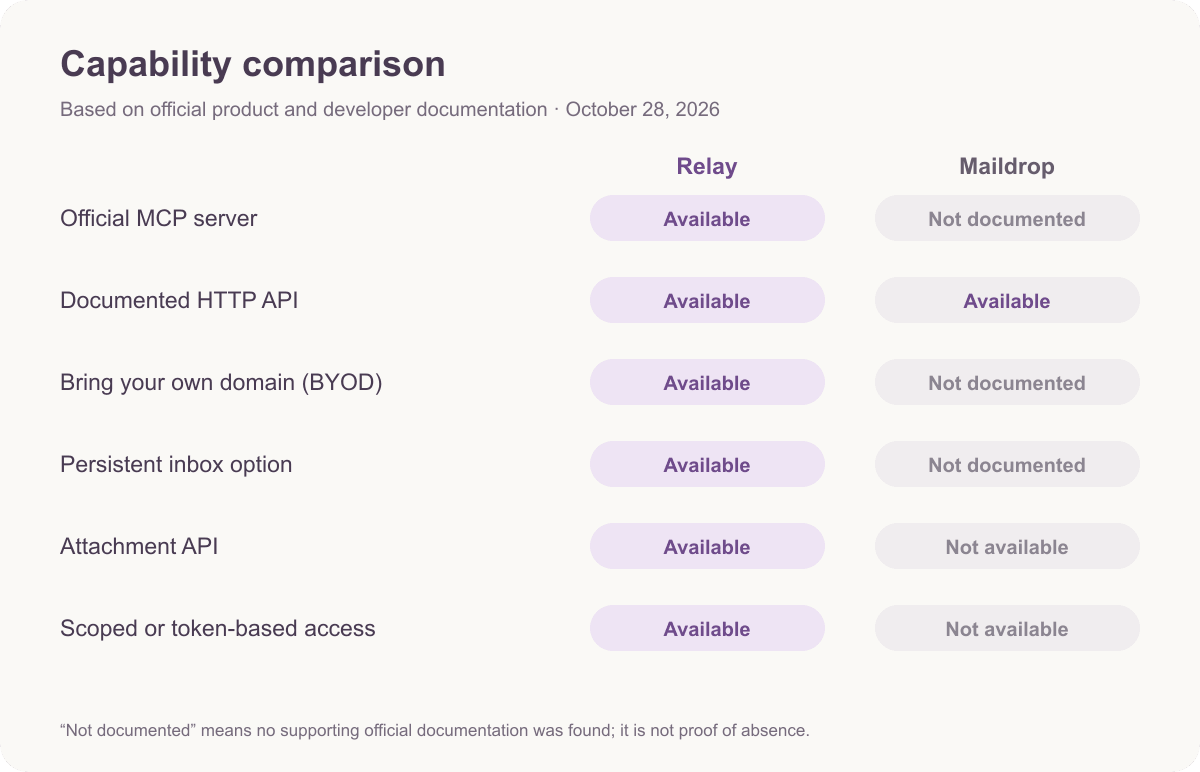
| Capability | Relay | Maildrop |
|---|---|---|
| Official MCP server | Yes: inbox and message tools | Not documented |
| Documented HTTP API | Yes: REST | Yes: GraphQL over HTTP POST |
| Bring your own domain | Yes: NS or MX, public or private | Not documented |
| Persistent inbox option | Yes: no fixed inbox expiry | Not documented; inactivity and capacity rules clear mail |
| Attachment API | Yes | No: attachments are removed and discarded |
| Scoped or token-based access | Yes: scoped, revocable keys and ownership | No passwords or sign-in security |
| Client guidance | REST and MCP documentation | Raw HTTP and Apollo JavaScript; Apollo Swift and Kotlin mentioned |
| Sending or reply | Not available | No sending under any circumstances |
| Inbox capacity | No fixed inbox expiry; no numeric capacity claimed here | Maximum 10 messages; oldest deleted |
Maildrop's GraphQL support is a genuine developer feature, not merely a website API afterthought. Relay's MCP support is equally concrete, but it serves a different integration preference.
GraphQL queries versus MCP tool calls
Maildrop hosts its GraphQL endpoint at https://api.maildrop.cc/graphql and accepts POST requests. A developer selects the mailbox and message fields the client needs rather than adopting Relay's REST resource shapes. The documented Message type includes data and html fields, which can support different content-inspection needs. Exact queries should be built against the current schema rather than copied from an assumed REST example.
The official quickstart demonstrates raw HTTP and use of the prebuilt Apollo JavaScript library. It also mentions Apollo Swift and Apollo Kotlin. These are Apollo client libraries, not official Maildrop SDKs; the distinction matters when evaluating maintenance and support. For a team already using GraphQL code generation and Apollo caching conventions, Maildrop can fit existing tooling naturally.
Relay instead exposes https://www.relaymcp.net/api/mcp with list_domains, list_inboxes, create_inbox, list_messages, and read_message. A compatible AI host can ask for a new inbox, retain the resulting ID, poll for a message, and read the selected result as part of an authorized test. Tool calls are explicit capabilities that can be inspected and gated by the host. See the Relay MCP guide for the transport and authentication model.
For custom applications, Relay's REST base is https://www.relaymcp.net/api/v1, using scoped, revocable Bearer keys. There is no official Relay GraphQL endpoint claimed here. A team committed to GraphQL may prefer Maildrop's native API; a team committed to MCP will find Relay's official tool surface more direct. The Relay API guide covers the alternative REST path.
No official Maildrop MCP, webhook, or AI-agent feature was found in the reviewed sources. An engineer could build an MCP wrapper around GraphQL, but that would be custom infrastructure rather than an official Maildrop capability.
Retention and capacity are part of Maildrop's contract
Maildrop documents several constraints that should shape a test harness. An inbox can hold at most 10 messages, and the oldest is deleted when capacity is exceeded. An inbox that receives no message within 24 hours is automatically cleared. Under high usage, inactive inboxes may also be cleared to make room for more active ones.
These rules can be desirable for low-sensitivity tests that should leave little behind. They are a poor match for delayed investigation, high-volume notification bursts, or evidence that must remain available beyond the documented window. A client should retrieve the needed message promptly and store its own result instead of treating Maildrop as an archive.
Relay has no fixed inbox expiry. That supports multi-stage agent runs, slower CI queues, and later human review. No numeric Relay capacity is asserted in this article, and no fixed expiry should not be confused with guaranteed permanent storage. Lifecycle cleanup and durable test evidence still belong to the operator.
Maildrop additionally limits plain-text or HTML messages to less than 500k. This is a documented message-size constraint, not a benchmark. Applications that generate large notifications should account for it before choosing the service.
Attachments: an explicit difference, not a documentation gap
Maildrop says all attachments in messages are removed and discarded. This is why the matrix says no for an attachment API: the underlying content is intentionally not retained for retrieval. Maildrop can still accept plain-text or HTML messages subject to its size rule, but an attachment-verification test cannot assume the original file will be available.
Relay exposes an attachments API, so it is the appropriate documented option when a test must enumerate or retrieve received files. That capability needs its own safeguards. Use harmless fixtures, validate content before parsing, and never allow an agent to treat attachment text as higher-priority instructions.
For HTML-only tests, both platforms can be relevant. Maildrop's schema documents HTML and data fields, while Relay returns sanitized HTML. Sanitization reduces markup-related risk but does not establish that links, claims, or instructions in the message are trustworthy. The email prompt-injection guide explains why agent authorization must remain separate from content cleanup.
Public access, privacy, and domain boundaries
Maildrop requires no signup and has no passwords or sign-in security. Any user can read any inbox, and aliases are obfuscation rather than secure access control. This is an explicit design choice. It makes setup easy, but it rules out treating a Maildrop inbox as a confidential destination for real password resets, personal data, or sensitive magic links.
Relay offers guest inbox passwords, account ownership, and scoped, revocable Bearer keys. Those features provide clearer boundaries between test runs and operators. They do not justify sending production secrets to any test system, but they are important when an authorized staging flow requires more than public-by-name access.
Maildrop's privacy policy says users should have no expectation of privacy and that connections are logged. It also says Maildrop does not track visitors, does not use cookies for personal information, and collects only email/web connections plus aggregate analytics through a pixel. Those statements should be read together rather than reduced to either “anonymous” or “no logs.”
Relay supports BYOD through NS or MX with public and private domains. Custom-domain support was not documented in Maildrop's reviewed sources, whose address model uses the maildrop.cc domain. That is not proof of an explicit permanent refusal; it is simply not a documented feature to build around. Relay's domain guide describes its current configuration choices.
Use cases and verdict
Choose Maildrop for a free, no-signup public test inbox, a GraphQL-first application, or a client that benefits from official Apollo JavaScript guidance and mentions of Swift and Kotlin clients. It is well suited to short, low-sensitivity checks where discarded attachments, public readability, and bounded retention are acceptable or even desirable.
Choose Relay for an MCP-compatible AI agent, scoped and revocable access, guest-password or account-owned inboxes, no fixed inbox expiry, attachment retrieval, or NS/MX public and private domain configuration. It is the stronger documented fit for controlled and repeatable agent workflows.
Maildrop is explicitly free, and no paid tiers were found in the reviewed official pages. Relay pricing is not inferred here. Cost alone does not resolve the choice because the storage and access models differ so substantially.
Relay also has limitations: no official SDKs, webhooks, server-sent events, automatic OTP extraction, or send/reply. Maildrop cannot send either. Relay users must poll and implement any OTP interpretation themselves; Maildrop users must work within GraphQL, public access, attachment removal, and retention limits. The verdict is therefore not universal: Relay leads for controlled MCP-driven testing, while Maildrop is attractive for lightweight GraphQL and Apollo-oriented workflows.
Frequently asked questions
Does Maildrop provide official Apollo SDKs?
No Maildrop SDK was documented. Its official quickstart demonstrates the prebuilt Apollo JavaScript library and mentions Apollo Swift and Apollo Kotlin. Those are Apollo client libraries, so they should not be relabeled as Maildrop-maintained SDKs.
Can I retrieve an attachment later from Maildrop?
No. Maildrop explicitly says attachments are removed and discarded. This is an documented restriction rather than an undocumented API detail. Relay exposes an attachments API for workflows that require programmatic retrieval.
Is Maildrop suitable for a confidential AI-agent inbox?
Its official material says every inbox is public, with no passwords or sign-in security, and aliases are only obfuscation. Use synthetic, non-sensitive data. Relay offers a clearer access-controlled model for authorized tests that need guest passwords or account ownership.
Sources and review notes
Reviewed October 28, 2026. These official links support the API, retention, access, attachment, and privacy statements; no unofficial feature claims were added.