Relay and Temp-Mail.org can both receive email for a test account, but they emphasize different parts of the workflow. Temp-Mail.org's homepage repeats phrases such as temporary, secure, anonymous, free, disposable email address, throwaway email, and tempmail—language aimed at keeping a real mailbox clean of spam. Relay is built around programmable inboxes for developers and AI agents, with both REST and Model Context Protocol access. The better choice depends on whether you need a quick manual browsing session or a controlled mail tool inside an automated test.
This comparison focuses on authorized development and testing, not bypassing a website's registration or anti-abuse controls. It also avoids treating disposable email as inherently anonymous or private. Those properties depend on the particular inbox and access model.
How this comparison was reviewed
I reviewed Temp-Mail.org's official service, API, terms, app terms, and privacy pages on October 28, 2026, and compared them with Relay's documented product behavior. No delivery-speed test, uptime benchmark, or deliverability score is claimed here.
Throughout the article, not documented means the reviewed official material did not establish a feature or limit. It does not prove that the capability is unavailable. Not available is used only where an official source explicitly rules something out. This distinction matters for attachments, API details, and access controls, where an absent documentation entry is not evidence of absence.
Feature comparison
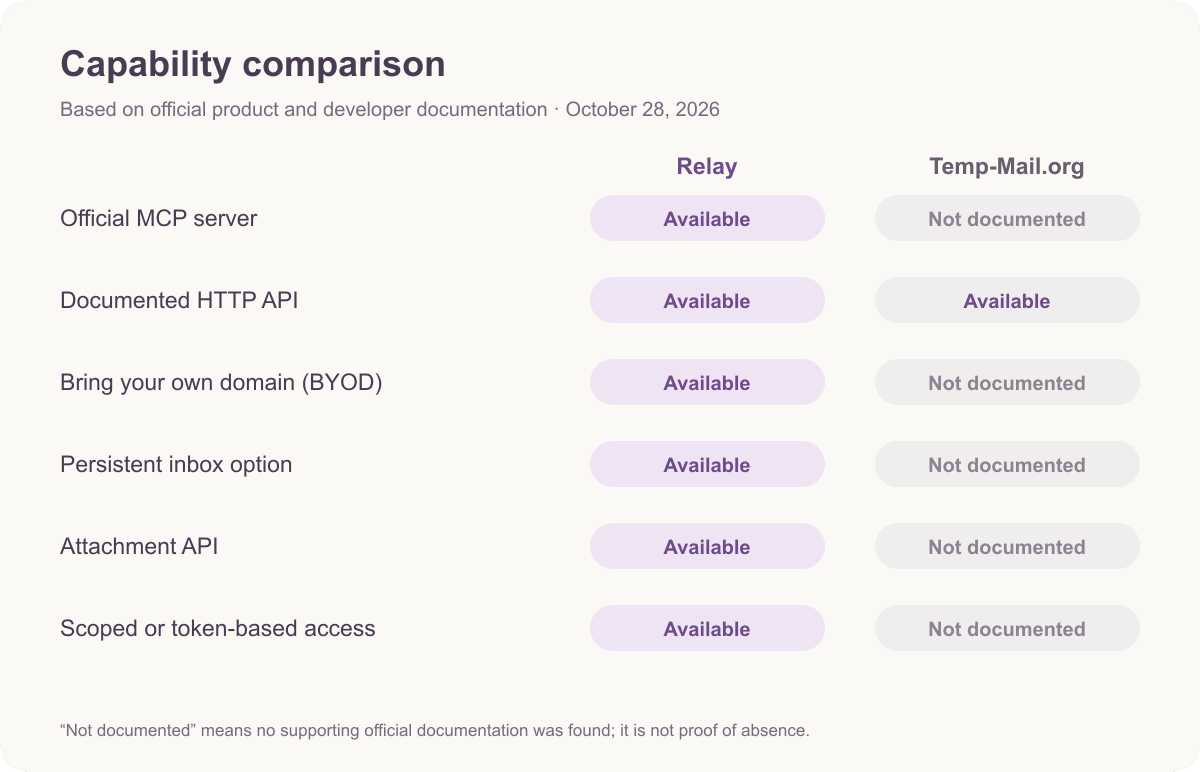
| Capability | Relay | Temp-Mail.org |
|---|---|---|
| Official MCP server | Yes: inbox and message tools | Not documented in reviewed sources |
| Documented HTTP API | Yes: REST with Bearer authentication | Yes: official temporary-email API |
| Bring your own domain | Yes: NS or MX, public or private | Not documented |
| Persistent inbox option | Yes: no fixed inbox expiry | Not documented; service is described as temporary |
| Attachment API | Yes | Receiving attachments is documented; an attachment API is not documented |
| Scoped or token-based access | Yes: scoped, revocable Bearer keys | Equivalent controls are not documented |
| Send or reply | Not available | Not documented; reviewed description is receive-focused |
| Fixed message-retention period | No fixed inbox expiry | Temporary, but no exact current period was found |
The table deliberately separates receiving an attachment from retrieving one through an API. Temp-Mail.org's app terms mention receiving emails and attachments. They do not, by themselves, establish a programmable attachment-download workflow.
Agent workflow versus temporary-email API workflow
Relay's most distinctive integration is its remote MCP server at https://www.relaymcp.net/api/mcp. An MCP-compatible host can call list_domains, list_inboxes, create_inbox, list_messages, and read_message. A typical authorized signup test discovers a domain, creates an inbox, stores its ID, submits the address through a browser, polls for a matching message, and reads only that message. The Relay MCP guide explains the connection model.
The same lifecycle is available over REST at https://www.relaymcp.net/api/v1, using an Authorization: Bearer key. This is useful when a CI job or custom agent runner does not need MCP. Scoped, revocable keys let the operator issue a credential for a particular responsibility and revoke it without treating the key as permanent. The API reference is the right place to confirm current routes and request shapes.
Temp-Mail.org officially documents a temporary disposable email API and offers a choice between two API management platforms. That is a meaningful advantage over browser-only disposable services. However, the reviewed record does not provide enough endpoint-level detail to describe an equivalent step-by-step agent loop here. A developer should evaluate its current API documentation directly rather than assume that its authentication, message retrieval, or attachment semantics match Relay's.
Retention, privacy, and access control
Temp-Mail.org explicitly describes its free system as public and warns users not to use it for private or confidential information, important accounts, or sensitive data. That warning should drive test design. Use synthetic identities and non-sensitive fixtures, and assume that an address alone is not a confidential access boundary. Premium exists, but the reviewed official material did not establish its precise inbox access-control behavior.
Relay offers guest inbox passwords and account ownership in addition to scoped API keys. These controls are relevant when a test notification contains a magic link or when several automated runs must not share one openly accessible mailbox. They do not make email content trustworthy: an agent should still validate the expected sender, subject, run identifier, and destination before following a link.
Retention also serves a different purpose in each product. Temp-Mail.org describes messages and mailboxes as temporary, while its terms say removed emails or domains cannot be restored. The exact current retention period was not found, so a test should not depend on a guessed number of hours or days. Relay has no fixed inbox expiry, which is useful when a delayed CI run or human review needs the inbox later. That is not a promise of permanent archival storage; retain important test evidence in your own controlled records.
Domains, attachments, and test evidence
Relay supports bring-your-own-domain configuration through either NS or MX records, with public and private domain options. This gives teams a way to align the test address with a domain they control. The domain documentation should be consulted for the current setup process. Custom or BYOD domain support was not documented in the reviewed Temp-Mail.org sources; that is a documentation gap, not a claim that no paid option could exist.
For attachment testing, Relay exposes an attachments API. Temp-Mail.org explicitly supports receiving emails and attachments in its app terms, which can be sufficient for a manual receive-only check. Before automating malware fixtures, large files, or attachment parsing, however, a developer needs documented API behavior and limits; those details were not established by the reviewed Temp-Mail.org pages.
Pricing and limits
Temp-Mail.org's terms describe a free basic service and paid TEMP-MAIL PREMIUM with additional features. An exact current Premium price and numeric API or web rate limits were not found in the reviewed official pages, so none are quoted here. Relay pricing is likewise not inferred in this article. Compare current plans only when the operational requirements—privacy, domains, retention, and integration—are clear.
Which should you choose?
Choose Relay when an MCP-compatible agent must provision and inspect inboxes directly, when revocable scoped credentials and inbox ownership matter, when a test may outlive a short disposable window, or when you need documented attachment retrieval and NS-or-MX domain configuration. These are integration and control advantages, not a claim of universally better email delivery.
Choose Temp-Mail.org when you want a recognizable free temporary-email service for low-sensitivity manual testing, value its documented attachment receipt, or intend to build around its official API after verifying its current details. Its free tier is a straightforward reason to prefer it for an occasional task that does not need MCP or Relay's access model.
The verdict is therefore workflow-specific: Relay is the stronger documented fit for agent-native, controlled, persistent test inboxes; Temp-Mail.org is the simpler candidate for casual receive-only use and for teams already committed to its API.
Relay limitations to include in the decision
Relay does not currently provide official SDKs, webhooks, server-sent events, automatic OTP extraction, or send/reply. An agent must poll deliberately, parse verification data in your own workflow, and use another system if the test requires outgoing mail. Relay's MCP tools also do not remove the need for approval policies, credential protection, and prompt-injection defenses. See the agent email security guide for that separate design problem.
Frequently asked questions
Is Temp-Mail.org private enough for password-reset tests?
Its official terms warn against using the public system for private or confidential information and sensitive data. For authorized tests, use synthetic accounts and avoid real secrets. If the reset link needs an access-controlled inbox, Relay's ownership and guest-password model is the clearer documented option.
Does Temp-Mail.org have an API for AI agents?
It has an official temporary-email API, but no official MCP or AI-agent feature was found in the reviewed sources. You could build your own integration. Relay provides both REST and a remote MCP server without requiring you to create that MCP bridge.
Can I test attachments with either service?
Relay documents an attachments API. Temp-Mail.org's app terms explicitly mention receiving attachments, but its reviewed pages did not document an attachment API or its limits. Manual receipt and automated retrieval should therefore be evaluated as different requirements.
Sources and review notes
Reviewed October 28, 2026. Claims about Temp-Mail.org are limited to these official pages; undocumented features are labeled accordingly.