ThrowawayMail is unusually explicit about serving AI agents: its official site provides an OpenAPI-described REST API, LLM-friendly documentation, and WebSocket notifications without API keys. Relay approaches agent automation through an official MCP server, scoped credentials, and inboxes with no fixed expiry.
This is therefore not a simple “API versus no API” comparison. It is a choice between frictionless, deliberately ephemeral automation and controlled, reusable inbox infrastructure. The live service reviewed is throwawaymail.app; the legacy .com domain was unavailable during research. All findings were reviewed on October 28, 2026.
Two different interpretations of agent-ready email
ThrowawayMail's /for-agents material speaks directly to machine consumers. It links Swagger, ReDoc, an OpenAPI 3.1 schema, llms.txt, and llms-full.txt. A coding agent can inspect machine-readable endpoint definitions, create a mailbox, poll messages, or subscribe to new-message notifications over WebSocket. No account, API key, or authentication is required; the documented mailbox handle is its mailbox_id.
Relay instead exposes mailbox operations as MCP tools at /api/mcp: list_domains, list_inboxes, create_inbox, list_messages, and read_message. This gives an MCP-compatible client a standard tool-discovery and invocation path. Relay also has a REST API under /api/v1, so choosing MCP does not exclude conventional backend integration. See the MCP setup and API documentation for the two surfaces.
Detailed feature comparison
| Capability | Relay | ThrowawayMail | Practical distinction |
|---|---|---|---|
| Agent integration | Official remote MCP server | Dedicated agent page, OpenAPI 3.1, and LLM-friendly text | Both are agent-relevant, through different interfaces |
| HTTP API | REST /api/v1 |
Free REST API with Swagger and ReDoc | Both permit custom HTTP automation |
| Authentication | Scoped, revocable Bearer keys | Explicitly no API keys or authentication | Relay emphasizes controlled access; ThrowawayMail minimizes setup |
| Inbox access | Guest password or account ownership | Mailbox identified by mailbox_id; stronger control not documented |
Treat mailbox IDs as sensitive handles, not scoped authorization |
| Inbox lifetime | No fixed inbox expiry | Exactly 10 minutes, then permanent deletion | Reusable identities versus strict ephemerality |
| Bring your own domain | NS or MX, with public/private domains | Not documented | Relay supports organization-controlled namespaces |
| Attachments | Attachment API | Not listed in the documented full-message response | Unknown is not a claim that attachments are blocked |
| Message body | Sanitized HTML through message reading | Text and HTML fields; raw source not documented | ThrowawayMail documents both text and HTML |
| Real-time delivery | No webhooks or SSE | WebSocket at /api/ws/{id} |
ThrowawayMail has a clear push-notification advantage |
| Sending and reply | Neither currently provided | No send or reply endpoint listed | Both are receive-oriented in the reviewed API material |
| Cost and request limits | No unsupported numerical claim made here | Completely free; no rate or usage limits stated | ThrowawayMail is explicit about frictionless free use |
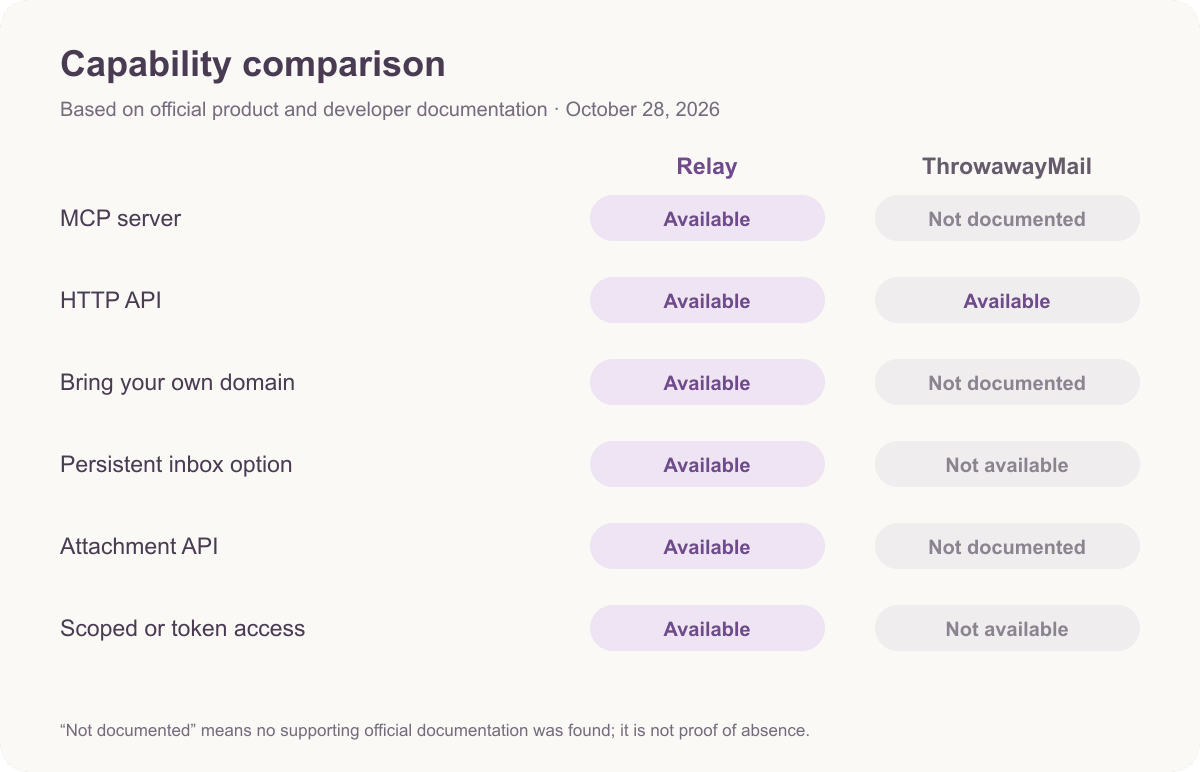
“Not documented” matters in this table. ThrowawayMail's full-message documentation lists text, HTML, and address fields but no attachments; that is insufficient evidence to declare attachment receipt impossible. Similarly, no official MCP support was found, even though its OpenAPI and LLM documentation are genuinely agent-oriented.
Integration architecture: MCP tools or OpenAPI plus WebSocket
Relay's advantage is a standardized agent surface combined with authorization boundaries. A team can issue a scoped Bearer key for a particular integration and revoke it without making every other credential useless. Account-owned inboxes support managed test environments, while guest inbox passwords offer a separate access model. This is useful when several automated runs must share a controlled namespace without sharing unrestricted credentials.
ThrowawayMail's advantage is immediacy. There is no credential-provisioning step, and its official OpenAPI schema can feed client generation or agent tool construction. WebSocket notifications avoid relying only on repeated message polling. For a worker that creates an address, waits briefly for one confirmation, and exits, this is a coherent and unusually low-friction design.
That convenience changes the security analysis. “No authentication” is an official product choice, not a hidden enterprise access-control layer. Protect the mailbox ID where appropriate, use only nonsensitive fixtures, and do not describe possession of an identifier as equivalent to Relay's scoped key model. The Relay documentation provides the relevant ownership and API concepts for the other side of the comparison.
A ten-minute lifecycle versus persistent test identities
ThrowawayMail states that emails, session information, and the mailbox itself are permanently deleted when the 10-minute window ends. There is no recovery mechanism. This limit is a feature for tests that should leave no reusable inbox behind, but it is a poor match for delayed mail, multi-step onboarding, or a regression suite that revisits the same account tomorrow.
Relay has no fixed inbox expiry, making it more suitable for stable test personas and asynchronous workflows. No fixed expiry should not be misread as a promise that every message is immutable or that cleanup is unnecessary. Teams still need retention guidance and credential hygiene. Review the privacy policy and contact support for questions about stored data.
Privacy expectations also differ. ThrowawayMail says it collects no personal information, does not track usage patterns, sells no data, and uses minimal logs. It also states that email is stored temporarily in plaintext and that valid legal requests are honored. Those are clear disclosures, but anonymity claims do not make message contents encrypted or suitable for secrets. Its policy prohibits illegal activity, harassment, spam, phishing, and malware, and IP addresses may be blocked for abuse.
Pricing and limits without false equivalence
ThrowawayMail calls its API completely free, with no usage limits, and separately states no rate limits. No paid plans were found in the reviewed official sources. These are meaningful advantages for disposable high-iteration prototypes, although they are not a throughput benchmark or an availability guarantee.
This review does not invent a corresponding Relay quota or price. Evaluate current Relay access through the account page, and evaluate domain requirements through the domain overview. A free, unauthenticated 10-minute API and a scoped persistent-inbox service have different operating models; a single price-per-inbox comparison would hide the most important differences.
Where each option is the better fit
Relay: controlled agent workflows and longer-lived fixtures
Choose Relay when an MCP client should manage inboxes directly, when scoped and revocable credentials matter, or when a suite needs a stable address across runs. BYOD through NS or MX is the stronger option for organizations that want public or private test domains under their own control. Relay's attachment API is also the documented choice when binary attachments must be retrieved programmatically.
ThrowawayMail: disposable tasks with immediate machine integration
Choose ThrowawayMail for a short confirmation flow where automatic deletion is desirable, WebSocket notification simplifies the worker, and no credential setup is a priority. Its OpenAPI and LLM-focused documentation make it better suited than Relay for teams that explicitly want to generate their own agent tools from a schema. It is not the natural choice for durable accounts or organization-controlled domains.
Relay limitations that may change the verdict
Relay currently offers no official SDKs, webhooks, SSE, dedicated OTP extraction, or send/reply. ThrowawayMail's WebSocket support is therefore a concrete reason to prefer it for real-time ephemeral tests. Conversely, ThrowawayMail has no official SDKs found in the reviewed sources either, and no documented webhooks, raw source, attachment API, MCP, or BYOD. These are documentation findings, not blanket claims of technical impossibility.
Frequently asked questions
Does ThrowawayMail support AI agents without MCP?
Yes. Its official agent page provides REST endpoints, OpenAPI 3.1, LLM-friendly documentation, and WebSocket notifications. MCP was not found there. Relay's distinction is an official MCP tool interface, not the only possible way for an agent to consume email.
Can a ThrowawayMail inbox be extended beyond 10 minutes?
No extension is documented in the reviewed sources. The privacy policy says the mailbox, emails, and session information are permanently deleted at expiry with no recovery. Use Relay or another controlled inbox when the test requires a longer-lived identity.
Is no-authentication access automatically less secure for every test?
Not necessarily; it depends on the threat model and data. It removes credential management for nonsensitive, short-lived fixtures, but it does not provide scoped authorization. For controlled environments, Relay's revocable Bearer keys and ownership models offer clearer administrative boundaries.
Sources and review notes
This review used official ThrowawayMail product, agent, API, and privacy material on October 28, 2026. It did not measure delivery speed, uptime, or deletion completion and assigns no synthetic score. “Not documented” means the reviewed official material did not establish a capability.
- ThrowawayMail home — live branded service, no-signup model, and 10-minute positioning.
- ThrowawayMail for AI agents — REST endpoints, OpenAPI, LLM documentation, WebSocket, authentication, and usage-limit statements.
- ThrowawayMail Swagger documentation — interactive official API reference linked by the research record.
- ThrowawayMail privacy policy — deletion, plaintext storage, tracking, logs, legal handling, and restrictions.